Search This Blog

Friday, February 02, 2007

Fish in the City

Some people regard the City of London as an exclusive club, a closed system that is inimical to outsiders, and in some senses, they are right.
The advantage of this, on a social level, is that once you are in, you are in and no questions asked.
For years, I have longed to visit one of the great institutions of the City, Sweetings fish restaurant, but was always put off by the fact that it is so obviously an insiders' haunt.
It is open only at lunchtime from Monday to Friday, from 11 o'clock until 3 p.m. in the afternoon and doesn't take any reservations. The seating arrangements are idiosyncratic – mostly around bars and counters, with one long table that must be shared with all other comers, and the menu is almost Spartan in its simplicity. Starters consist of things like smoked salmon and brown bread, or crayfish cocktail, while the main courses run to fried haddock and chips, steamed sea-bass, and scampi.
My curiosity was finally sated recently when a Sweetings regular offered to be my escort for a leisurely lunch. He was warmly greeted by name, not just by the maitre d', but also by the waitress, the bar staff and the head chef, who came out from his lair specially.
I didn't like to demur when he suggested we start with Black Velvets, which to my mind are usually a waste of good champagne and good Guinness, but then I've never drunk them out of silver tankards before. I don't know if it was the receptacle, the quality or the friendly service, but this was a delicious if filling drink.
The crayfish cocktail was supplemented with generous amounts of lobster, by special request, and my breaded fried haddock was excellent. The accompanying chips were good, but the star of the main course, oddly enough, was the spinach, which was plentiful, beautifully seasoned and had just the right amount of butter on it.
We eschewed the public school dessert menu (sticky toffee pudding and the like) in favour of a savoury – Welsh Rarebit, made with cheddar cheese, mustard and ample Worcestershire sauce.
At this point we ran into another of the idiosyncracies that make Sweetings seem impenetrable. They don't serve coffee. Still, by this time I was enjoying myself so much, and had made such good friends with the staff that I was prepared to forgive even this, on the grounds that this was how it had always been.

Monday, January 29, 2007

Just a dab behind the ears

What do you want for your birthday? What should he pick up in duty free to make you happy?

A bottle of expensive perfume - Eau de Stilton would be perfect.

Isn't it sad that it's ten months till my birthday?

And do you think they make a bubble bath?

Thursday, January 25, 2007

Don't mention the S-word

One of the greatest cheese debates is whether it matters if you make the cheese with raw or pasteurised milk. Food safety and taste are the two main heads on which people argue, but in the case of cheeses that are PDO (protected denomination of origin), it may in fact be a business issue.
I recently tried a new unpasteurised blue cheese. Not just new to me, but an experiment on the part of its makers, it is called Worksop Blue. It is an interesting cheese, not because it is particularly delicious, (the makers are still working on perfecting it), but because it is a possible source of contention with a powerful special interest group.
The little placard that gives information about it in the cheesemongers has a special notice on the back, where only the cheesemongers can see it, warning them not to mention a certain traditional English blue cheese in connection with Worksop Blue.
Stilton is one of a baker’s dozen of British cheese that have the sought-after PDO status, and its definition includes the rule that it must be made of local milk, pasteurised before use. Anything that is not pasteurised is not Stilton and cannot be sold as such.
I’m not sure if the cheesemonger who said he was afraid his enemies would report him to the Stilton Cheese Makers Association, but the fear of what can be done with a cheese iron and a length of cheesewire kept me from enquiring further.

Thursday, January 18, 2007

Can't curl but can swim, Stickly Prickley, that's him


Over the last month or so, I've been far too busy cooking and eating to find time for writing on compulsivecook. Among the highlights have been a fabulous roast of beef on Christmas Day, a ten course meal on New Year's Eve near Nice, including a traditional Saarland-style barbecue where the marinaded pork was laid on a circular grill suspended spinning above the coals and a whole heap of foie gras.
I'm hoping to write at greater length about some of these things soon, but in the meantime I want to record my first experience of eating sea-urchin.
Before leaving Nice, we went to a delightful seafood restaurant where not only did we eat a surfeit of delicious oysters (just like the Walrus and the Carpenter), but the very nice waiter was easily persuaded to let me have a single exploratory urchin gratis.
My companions were very discouraging: the one who had actually eaten them before made horrible faces and tried to dissuade me, while the only other prepared to contemplate seafood was keen to watch me eat one but refused to commit to trying it herself.
I might have been daunted by this lack of support but for the family at the next table. This exemplary French family had piles of oysters, whitebait and urchins, and the two boys (both under ten, at a guess) were eagerly competing to get their share of the platter of spiny balls.
So, my sea-urchin.
It came in solitary state on a silver salver. It had been opened already, and it turns out that there is virtually nothing to one of these sea-hedgehogs. A little reddish cruciform strands of slightly chewy slime, salty and sea-tasting, disappeared in seconds. I'm not sure I liked it, exactly, but then I'm not sure I liked my first oyster.
However, given how rarely they seem to be available in my part of the world (North London), it's probably better for me not to cultivate a taste for them.

Tuesday, December 12, 2006

The rudest mushrooms you'll ever meet


They were labelled 'Egg Mushrooms, England' on the stall, and they do indeed look quite ovular. Touch them, however, and the impression changes. Their velvety skin encloses a thick layer of gel surrounding a small firm capsule.
The people on the stall had no idea as to what they might be, how to cook them or whether they might be palatable.
Naturally I filled a brown paper bag and set off to challenge all comers. Mostly it was just fun watching people pick them up. Their expressions would flip to bewilderment and mild disgust as they bit back the immediate reaction: "But they feel like testicles!"
I tried all my foodie friends, the manager of the Chinese restaurant where I ate that evening and the staff at Carluccio's.
There we neglected all the other customers to look the eggy mushrooms up in Carluccio's mushroom book, but to no avail.
Finally the Man (who had only heard them described over the phone) somehow came up with an identification from a website. My 'egg mushrooms' that so sensually resembled hairless testicles were the immature form of a charming fungus known as the stinkhorn, or phallus impudicus.
If left unpicked for another 24 hours, they would have sprouted into foul-smelling phalluses. Judging by the online photos, these were probably the something nasty in the woodshed that traumatised Aunt Ada Doom.
All references made it clear that the mature form was inedible, even for the least squeamish, but some half-hearted allusions were made to cultures in which the eggs are a 'delicacy'.
Never one to shirk a challenge, I skinned them, washed off the extremely tenacious gel and sliced the surprisingly hard nubs to fry in butter. They were unpalatable to the point of being not worth eating. After four mouthfuls, I threw the rest in the bin, regretting only the waste of good butter. The mushrooms themselves had provided me with enough entertainment to more than merit the money spent on them.

Sunday, December 10, 2006

The realisation of a dream

Have you ever looked forward to something so much that you were sure it couldn't live up to expectations? Eating at Heston Blumenthal's restaurant the Fat Duck was one of those experiences for me, but he didn't let me down.
Nestled in a small town half an hour by train from London, the Fat Duck looks unpretentious to the point of being self-effacing from the outside. On entering, you are conscious of warmly welcoming staff and plain but good décor. Then you sit down, notice that the starched white linen napkin has the name and logo of the restaurant woven into its fabric and after that there is no time for details that are not about the food.
The tasting menu provides some 18 or 19 courses, many of them minute and all witty.
Blumenthal is famous as a pioneer of 'molecular gastronomy', a fancy name dreamt up for even fancier application of science to cooking. He likes to put flavours and concepts together that sound like bad dreams and taste like marriages made in heaven. Sardine on toast sorbet or vanilla mayonnaise maynot come from any culinary tradition, but if you are open-minded enough to taste them, you will be surprised at how well they work.
Surprise is a major element in the food here, whether it be the orange and beetroot jellies, where the colours belie the flavours, or the nitro-green tea and lime mousse Œcooked¹ in liquid nitrogen and disappearing almost instantly in your mouth.
A begrudger might wonder whether the trickery has taken over from the fundamental cooking, but dishes such as the roast foie gras with almond fluid gel, cherry and chamomile would quickly reassure any doubts. The foie gras is perfect, the chamomile pointing its flavour beautifully, while the combination of almond and cherry enhances the sweet cyanide bitterness of each to counterpoint the rich savoury meat.
Hot and cold are also dimensions in his culinary universe. In the kitchen, Blumenthal has experimented with cooking things at different temperatures; salmon poached with liquorice was cooked sous-vide, sealed and poached for a long time at a very low temperature, turns out meltingly soft but with an essential and subtle flavour that is complemented as much as overwhelmed by
the liquorice.
The glass of hot and cold tea that comes at the end of the meal is hot when drunk from one side of the glass and cold from the other. This playfulness is evident throughout the menu ­ only go to the Fat Duck if you are prepared to be open-minded and like to be entertained.

Wednesday, November 22, 2006

As well hung for a sheep as for a lamb

There are occasional campaigns to revive the British tradition of eating mutton, but they never seem to get very far. This doesn’t seem too surprising, given that the British seem to value tenderness in lamb far above flavour, although that may also explain why the mutton stalwarts continue to fight the good fight.
Having spent years failing to find lamb in the UK that carries the savoury depth of flavour that a Wicklow sheepfarmer’s daughter considers a prerequisite, I was very open to conviction on the subject of mutton.
My first foray, an attempt at Irish stew, was disastrous. The flavour was no more than ok, and the meat was almost inedibly tough. Given that I was trying out recipes for a buffet, this was an important consideration!
But this week I wandered into überbutcher the Ginger Pig to enquire about their advertised butchery courses (watch this space for further details!), and was tempted by a display of cubed Swaledale mutton, hung for 28 days and advertised as perfect for curry.
I chose a Rajasthan recipe (based on the fact that this was the only recipe I could find for which I had all the ingredients in the kitchen) which involved a teaspoon of whole cloves and a dozen dried chillies.
This ferocious dish cooked for about an hour and a half, reducing the spices to a fabulously rich, thick gravy, and I’m happy to report that mutton was precisely the right meat to stand up to this abusive treatment.
Despite looking worryingly sinewy when it went into the pan, the mutton had turned into tender chunks with a rich meaty flavour that was not overpowered by the curry sauce.
Only the fact that there is something irredeemably wrong with my rice let the meal down. Originally I assumed it was just bad karma that meant my rice wouldn’t cook right, but now I think it’s just too old. I will buy some new rice and report back on whether my karma improves.

Sunday, November 19, 2006

My new motto


This delightful Italian deli gives the impression to the casual customer that it is most interested in salami and different hams (to great effect), and the counter of cheese at the back can seem like an afterthought. However, take a step back and it's clear that the owners have a fine sense of priorities.
CHEESE NEVER SLEEPS!
I'm not at all sure that I know what this means, but it feels like my kind of motto.

Wednesday, November 01, 2006

Choices, choices

I have mentioned my favourite cookbook, The Joy of Cooking, before, and I may even have written about the difficulty of choosing between the different editions available. There is now a new version,, but the reviews don't convince me that it's worth getting one sent over from the States specially.
This review doesn't mention that there is also a UK version of the 1997 edition - but if you're that knowledgeable about the Joy concordance, you also know that it's not worth the pounds sterling.

Tuesday, October 24, 2006

Don't watch - I'm eating truffles

Tolkien’s hobbits were inordinately fond of mushrooms. Although I don’t think of myself as hobbit-like in any other way, I sometimes worry that there is something sinister about how much I like eating fungus.
My first experience of eating fresh truffles was at a reception held by a French investment bank. I couldn’t tell you which one, anymore than I can remember anything about the speech that the chairman made just after the very simple pasta with truffles was served.
Nobody had warned me that the real attraction of truffles is that they taste subtly but unmistakeably of sex. Eating truffles in polite company is like watching an erotic Japanese arthouse movie with your parents. It’s not totally taboo, because it’s a classy film, but you are embarassed by how beautifully sexy it is.
Sadly, almost the only way I can afford to eat really good truffles is when it’s being paid for on an expense account, so I have spent a lot of time wondering how much the embarassment blunts my enjoyment of these subterranean jewels. The conclusion I have come to is that it’s always worth it, even though it sometimes makes me very resentful of the generous person simultaneously buying and ruining my lunch.
Until my ship comes in, I am very happy to stick with more plebian mushrooms in my own kitchen. This cep formed the main flavouring ingredient in a richly comforting risotto last week, while pieds de mouton, English boletus, slippery jacks, girolles , chanterelles and shaggy parasols made a wonderful mushroom stew to accompany a savoury pie.

Thursday, October 19, 2006

My dog has no nose. How does he smell?

The morning after a delightful evening at which my wine-writer friend supplied the drink and my affineur friend the cheese, I opened the fridge to get butter for toast. Even though the fridge door was only open for perhaps thirty seconds, this was long enough for an invisible fume of dank, drain-like smell to escape, hover a minute or so in the kitchen, then wind its poisonous way through the flat to the bedroom, where it woke up the Man quicker than I’ve ever seen him come to consciousness on Sunday morning before!
The cheese, wrapped though it was in several layers of waxed paper, was not asleep.
What is the relationship between smell and taste? The theory is that we have tastebuds for just five flavours: salt, sweet, bitter, sour and umami. All the other delicate arrangements of flavour that we experience while eating are actually through the olfactory bulb in the nose.
If this is the case, why do we experience the smell of so many food stuffs as so different from their flavour?
As a child, coffee seemed repellent to me to taste, but I used to go out of my way coming home from school in order to sniff the air next to the coffee stall on the market. Durian fruit is notoriously bad-smelling, but pleasant to eat. And cheese can smell like a teenage boy’s gym kit but be absolutely delicious.
I think (and this is based on nothing more than personal observation and wild speculation) that there must be some change in how we perceive things that are inside our mouths. The smell may be the same, so the olfactory experience is technically the same, but it is now combined with a mouthfeel (cool, salty, fattiness in the case of cheese) and our expectations of the sensation is altered.
By this latter, I don’t just mean that we expect the époisses to taste good, but that it fills our sensory horizons so we no longer have a standard of non-smell to compare it with. When I worked in the cheesemongers, many customers (not all under 8) would wrinkle up their noses on entering the shop and perform amusing mimes of themselves vomiting at the smell. If they didn’t immediately flee in fits of laughter, we were always able to cure their nausea. A taste of cheese, ideally Montgomery’s Cheddar, would instantly dispell the tyranny of the air heavy with the aroma of dozens of cheeses.

Wednesday, October 18, 2006

Turkey twizzlers? I don't think so!

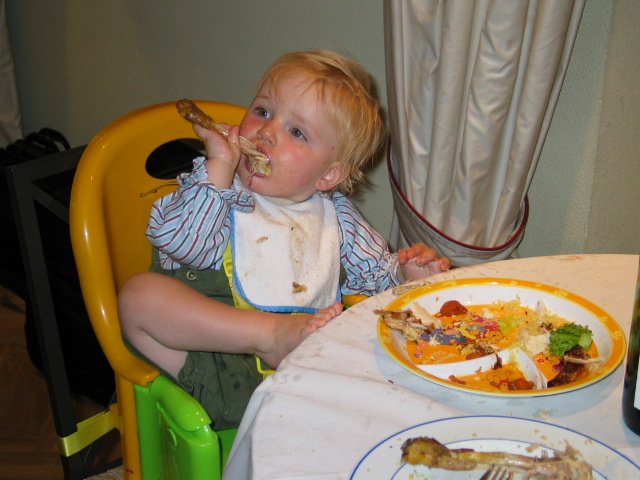
I had all sorts of clever and profound things to say about the importance of introducing children to good food early on. I was also planning to boast about my friend who devoted a large amount of her maternity leave to steaming and puréeing organic fruit and vegetables, then freezing them in ice-cube trays so that Baby Louis would be able to have gourmet mixtures at every meal (apparently six veg-cubes constituted a meal). But in the end, the picture of Louis, now liberated from the strict vegetable diet, enjoying a hearty gnaw, speaks for itself.
This is how to enjoy food!

Monday, October 16, 2006

Radio review

One of the best things I have ever heard on radio was yesterday's Food Programme on BBC Radio 4. This is partly because it was dedicated to the potato, a topic close to my heart, but mostly because they were featuring an entirely straight-faced report on the 6th annual Festival for the Recognition of Sauté Potatoes with Onions as a Main Dish. Go to the website, listen again, and never again regard Sauté Potatoes with Onions as a menial side dish.

Irregular verbs

Have you ever noticed that, in languages other than the irrepressibly irregular English, it is the most commonly used verbs that are least regular? To a student, this can seem like a willfully excluding trait, putting the highest hurdle first; but of course it is perfectly understandable that the words that are most used are those that get rubbed into different shapes. Those shapes may seem unreasonable to the outsider, but they are comfortingly familiar to native speakers.
In the same way, it is the basic building blocks of a cuisine, universally used and often ignored, that are hardest to replicate in another country.
Everyone knows that the Irish are fussy about potatoes, so no-one is surprised when I lament the lack of ‘balls of flour’ in English greengrocers, but even I am taken aback by how much I still miss Irish bread. Not the brown (soda) bread that I could make for myself or even buy by going to the right London supermarket, but plain old Irish sliced pan.
After years of vague disappointment every time I had toast (Kerrygold butter is available here, so I knew that wasn’t the problem) I identified the issue: it wasn’t chewy enough.
I don’t know if it’s because of the damper climate, which might affect either the wheat itself or the rising process, but Irish bread is almost without exception chewier than its English equivalent.
It’s not necessarily better, but it’s how I like it. The glutinous verb of chewing bread is familiar to me and anything else tastes like a foreigner saying “I goed” instead of “I went”.
Even grand organic freshly baked bread is usually less chewy than I want it to be, but I have finally found a source of bread that is delightfully tough, although packed with flavour.
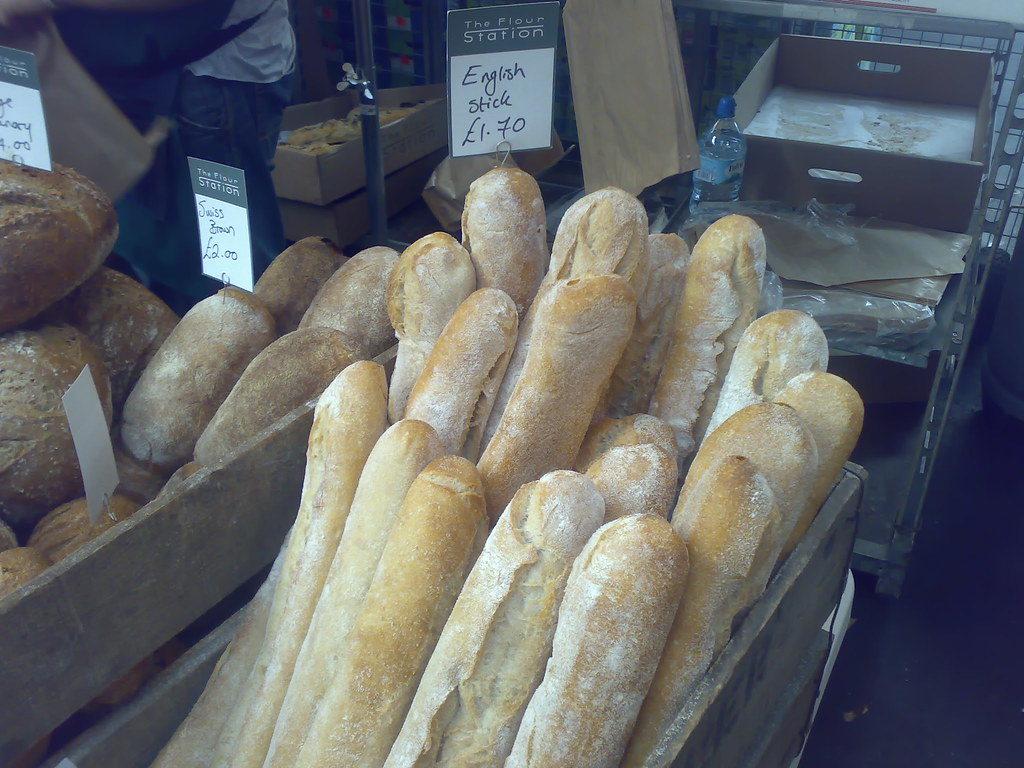
The Flour Station now has a weekly stall on Borough Market, where the staff are unfriendly until you show an active interest in their bread, at which point they open up and tell you in detail about their lengthy proving, the importance of the ingredients and how they are treated and how to look after the bread they are selling you. Apparently the difference is that any loaf of bread you buy from them has taken nearly 24 hours to reach its farinaceous apotheosis, which gives the gluten time to develop. Last week I spoke to a relatively junior assistant, who told me to come back when his boss was there to explain the science behind it. I plan to spend the intervening time reading Harold McGee’s account of bread-making, so as to be able to ask intelligent questions. In the meantime, I will live on the memory of the country levain, the English stick and even the olive-oil laden focaccia.

Tuesday, October 10, 2006

One query answered, another posed


Thank you to Mat, who tracked down real Israeli couscous for me! It’s simple to cook and tastes exactly as it does at the Table, where I first came across it.

Now my only query is: what is the other stuff that I found? It’s more porous than the Israeli couscous and took forever to cook. It might be nice as a thickening in stew, I suppose, if one liked that kind of thing.

Betty Botta bought some butter


My grandmother, continually angry at being forbidden the high cholesterol of full fat dairy produce, reminisces about the days in the 1950s when her farming household consumed two pounds of butter a day. “One for your grandfather and one for the rest of the men.”
For the last forty years or so of his life, she never spoke to and rarely of my grandfather, so this snippet was memorable. She doesn’t know, or probably care, that he continued to consume butter in gargantuan amounts, only that she is forbidden to do so. Perhaps that is why she has outlived him.
Although falling short of Grandpa David’s heroic standards, I have inherited the family love of solid churned cream. Spread thickly on bread or used to fry almost anything, even melted into egg yolks to form hollandaise sauce, butter is one of my favourite food stuffs.
This has been the case for many years, but until recently I was under the impression that the only decision to be made about butter was ‘salted or unsalted.’ It is only recently that I have come to appreciate how much it can vary. My first inkling of this variability came at a point when I was trying to economise, and thought that one easy way was to buy cheaper butter from New Zealand in place of the heavily subsidized but still more expensive Kerrygold that I had been in the patriotic habit of buying.
This change in buying behaviour was also driven by a brief flirtation with economics, a friend having ranted to me about the iniquities of the European common agricultural policy. I did my bit for free market butter economics for a couple of weeks but was soon driven back to the protectionist stuff that did not go rancid so quickly.
This may be simply because it is more highly salted, as is my taste, but the underlying taste is also sweeter to my palate.
Having worked out this difference, it became clear that it might easily be worth spending money on expensive butters to find the best, or those bests that are most appropriate to different needs.
Since then I have wasted much money, raised my own cholesterol level and tasted many different kinds of butter. I know that it can vary in colour, texture, saltiness, firmness when refrigerated or not, keeping quality and sweetness. It can be made with fresh or fermented cream, or even the whey from cheese-making. Contrary to expectations, a higher water content is often a good sign, although it’s not clear whether that is because it associated with artisanal methods of churning and the higher quality ingredients that implies, or is actually a good thing in itself.
In the last few weeks I have sampled bright yellow and crystalline clotted cream butter, smoother whey butter, which is not noticeably less sweet, the familiar salty smoothness of Kerrygold (the standard Irish butter, originally produced by the Kerry Co-op and marketed internationally by one Tony O’Reilly, who went on to head multi-nationals Heinz and Waterford) and the pale sweetness of the French butter sold in Borough Market at a specialist butter stall, sliced from demi-tuns and eaten irresistibly with a London bloomer loaf.
I wouldn’t eat a pound a day of the latter, but only because I can’t afford it; my next plan is to try making pastry with it.

Sunday, October 08, 2006

Colourful cuisine

A colleague of mine recently went to the restaurant Dans le Noir, where blind staff serve you in the dark. She reported that it was disappointing to discover that her other senses were not stimulated by the deprivation of sight, and that she would not care to repeat the experiment.
‘Experiment’ is my word, and expresses the only way I think one could approach such an experience. Such temporary sensory deprivation is unlikely to give enough time for other senses to compensate, so the point of eating in the dark must be largely to bring home to one how important sight is to the enjoyment of food for most people. When I was little, we used to play around with such ideas by doing things like being blindfolded and being fed randomly cubes of onion and of apple, or eating assorted sandwiches with our eyes closed.
Certainly there are all sorts of visual cues that we pick up and interpret, without having to think in such sophisticated terms as aesthetic impact. Food needs to be the right colour for us to be comfortable eating it; apparently we are conditioned to be suspicious of blue food, but food that is inappropriately green, or darker than it should be, or even just brightly coloured and unfamiliar, will also set off alarm bells.
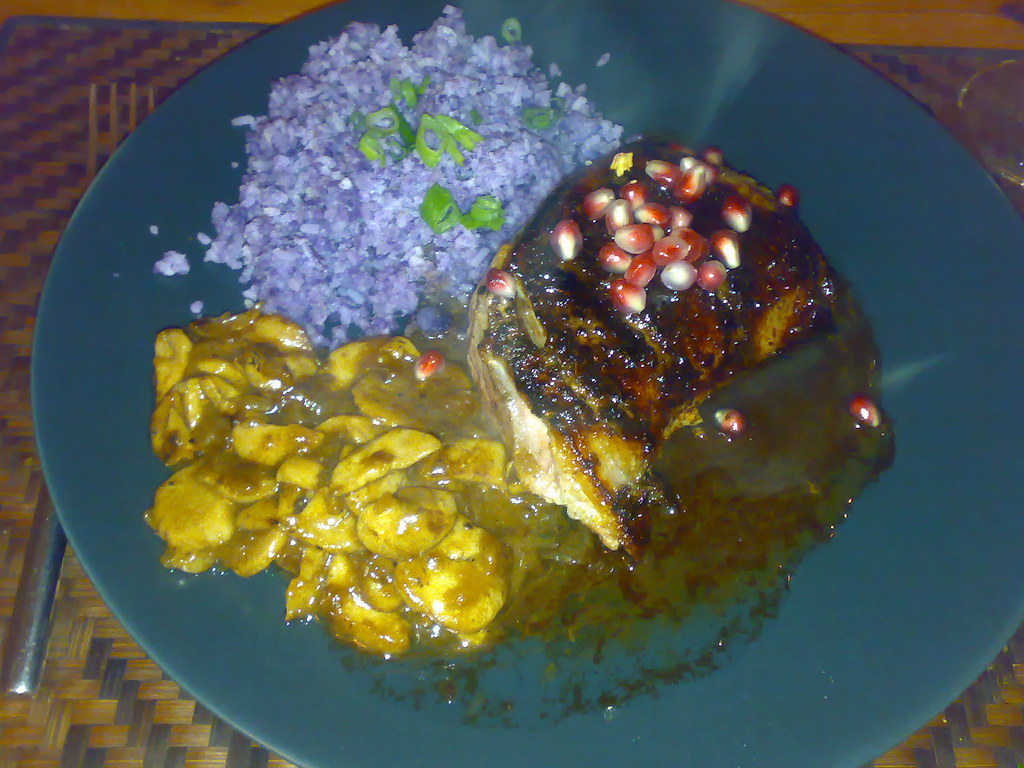
Whatever the evolutionary reason for the attention we pay to the appearance of food, it can now be used to enhance our enjoyment. One of my personal indulgences is the occasional purchase of black truffle potatoes, which are unprepossessing in their natural state, looking like dirty dark purple Jerusalem artichokes, dull and knobbly. When boiled, peeled and mashed, they turn into a wonderfully episcopal purple mass, with a dry, floury texture and an earthy, almost fruity flavour. With a garnish of spring onion tops for contrast, they make a beautiful third of a meal that also involves the jewelled red of pomegranate seeds on top of the fried duck-breast with a pomegranate sauce and the startling yellow of braised ceps.
Although the flavours were delicious, a great deal of my pleasure in this meal came from the simple joy of the bright colours together - I would love to go to Dans le Noir, but only as an experiment.

Thursday, October 05, 2006

Everybody eats

Charles Campion is indubitably an accomplished restaurant reviewer, while only the most embittered begrudger would claim that Heston Blumenthal is other than a gifted and massively dedicated chef.
Campion however seemed blind to one of the most basic issues surrounding food, while Blumenthal was adept at avoiding the question of why Campion’s teenage children seemed open-minded at a sixteenth birthday lunch at the Fat Duck, but insisted on tomato ketchup on anything supplied by Campion himself.
Do we have to remind you of the tensions surrounding relations between parent and teenage child, Charles?
The reason food is an infinitely fascinating topic is precisely that everyone has to eat, so that it is an infinitely available battleground for power; person, political or absolute. If you are lucky enough to live in a society where sufficient food for basic nutrition is not an issue, it almost inevitably becomes a locus for expression of family relationships with all the complexity that implies.
To express bewilderment that a teenage child rejects your strongly held food-related values is surely disingenuous. It may be excusable in terms of your family relationship, but it is to ignore the fascinating psychological and power structures surrounding food.
Everybody eats. This basic fact means that food can never utterly dissociate itself from the need for survival, so of all art forms in our over-civilised society it is the most unsettling, the most decadent.
Campion complained that while an opera critic may be asked to stand in for the food critic on a newspaper, the reverse never happens. He sees this as an indicator of how lowly food is valued. Rather I think it is a sign that editors feel, rightly, that everybody eats, and anyone who is used to thinking critically can apply that skill to a universal act. It is hard to refute this opinion; the onus is on food writers to prove that we have something more to offer than simply a report on whether the steak was overdone.

Removing sandals on holy ground

Tonight I went to hear a demi-god of contemporary cooking and was confronted with a veritable god of the pantheon. Evening Standard reviewer Charles Campion was soi-disant ‘warm-up’ for Heston Blumenthal, who casually referrred to ‘Harold’ in the audience. This was Harold McGee, author of McGee on Food & Cooking, for whose signature I queued up with a collection of similarly awestruck foodies.
I first heard of McGee’s work in the early nineties when visiting my plant geneticist aunt in Palo Alto. Her foodie/scientist friends insisted to this embryonic compulsive cook that no-one could be serious about food without knowing this cross-over writing from an English graduate with an interest in chemistry.
14 years later, I was overwhelmed by the presence of this inspirational pioneer, who coined the term ‘molecular gastronomy’ but still seemed pleased to hear about my recurring awe at the everyday magic of food.
Anyone who has ever wondered at the alchemical transformation of clear egg white into firm white foam after beating or opaque rubbery whiteness through heat should read McGee for an enlightening, empowering and exciting exposition of the alchemy of cooking.
Cooking is quotidian conjury, chemistry and physics at your fingertips, and McGee explains it without removing the spark of excitement. No self-respecting cookery shelf is without his masterpiece, although not everyone is lucky enough to have a signed copy from this personally charming sexy greybeard!

If you take school dinners....

"If you take school dinners,
Better set 'em aside.
A lot of kids didn't.
A lot of kids died."

There is a lot of debate about school dinners going on in the UK at the moment, but it can be hard for a foreigner to engage with it.
How shocking we are supposed to think it that there are schools that have no kitchen at all! But no school I ever went to in Ireland had a kitchen. The more luxurious ones had hot soup available at morning break.
One secondary school in the London borough of Hackney makes a big thing of its healthy living ethos, which involves banning vending machines from the school (good, but why in the world were they let in in the first place?) and forbidding students to bring packed lunches. Huh? What’s wrong with packed lunches? Admittedly I hated packed lunches, but then I hated every aspect of school, and the idea of taking some responsibility for one’s own nourishment is not a pointless one.
In Charlottesville, Virginia, where I spent one term aged 10, all schools in the district had the same menu each week. This menu was announced on local radio (I never missed corn on the cob day), so that students and their families could decide if they wanted to eat school food or bring a packed lunch. It is now available on the internet , parents are as welcome as ever in the canteen and the menu looks remarkably similar to my memories of more than two decades ago.
My two worst school dinner experiences were indeed in the UK: at primary school in a very deprived area of Liverpool, we were convinced that the second sitting of lunch had to finish up whatever the first sitting left. Burned in my memory is the time that a small boy at my table (we were all small, but he was naughtier than most) stirred his pudding into a disgusting pink moosh, then refused to eat it. The table monitor pleaded with him, explaining that it was unfair to leave this horror for second sittings, but in vain. How grateful we all were to the capricious authorities who had declared we got to eat first!
Another stint at a UK school came some ten years later, when I volunteered to report on the otherwise unvisited school canteen for the School Council (a very democratic institution).
The air surrounding the canteen building was thick with grease, while the interior was how I imagine a temporary army canteen might be, right down to the terrifying people serving the food. Marked out as exceptional by our age and non-uniformed status (only the lower orders in the first three years usually ate there), my head-girl friend and I had to force down our oily burgers and cold chips under the glaring eye of the head dinner lady.
Returning to the Irish morning ritual of putting together two cheese sandwiches, a piece of fruit, a packet of crisps and a drink did not feel like a return to deprivation.