Search This Blog

Thursday, April 29, 2010

Bread in the drawer

For a year as a difficult teenager, I lived in the house of my godmother, her husband and their three children. It's a lovely house - a huge Victorian end of terrace monstrosity, painted pink, in the Dublin seaside suburb of Dun Laoghaire.
One of the nicest things about it was the biggest kitchen I've ever been in, with lovely dark green cupboards and units lining one wall. Next to the sink were some drawers - if you opened the second drawer down, you found the bread board, the bread knife and the bread. This was always the same, huge flattish round loaves made by Michael from Darina Allen's no-knead recipe.
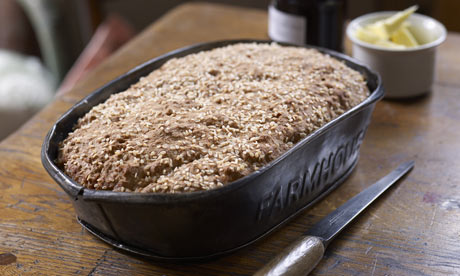
My success with the white yeast loaves last week emboldened me to try my hand at this recipe, which uses treacle to speed up the yeast. It creates a very wet dough, and takes a total of 90 minutes to make, including 20 minutes rising time and an hour in the oven.
The main stumbling block was that the recipe calls for a tin 5 inches by 8. I don't have anything even close to this in my vast collection of baking tins.
In my first effort, I used two 1 lb loaf tins, and I think I didn't let the yeast brew or the dough rise for long enough, because I ended up with two aromatic but totally solid bricks of bread.
Undaunted (or at least not very daunted) I tried again, taking more care to give the yeast a chance and using a square tin usually used for Christmas cake.
This was much more satisfactory, even though the crust is still vaguely reminiscent of Storm Troopers' armour. At least the crumb is soft and completely cooked and tastes nice.
The other difference between the first two was the flour I used. The recipe calls for 450 g of wholemeal flour, or 7 parts brown flour to one of strong white. I used all strong flour, brown and white the first time, and the second time, I used 3 parts strong brown flour to one of plain white. (I'm trying to use up the strong brown, which got substituted into an internet grocery order).
I'm hoping that a few more attempts (and possibly some plain brown flour) will see me producing bread worth keeping in a drawer.

Friday, April 23, 2010

If it comes out of the ground...

My motto, used to justify my dislike of parsnips, turnips, carrots etc, is "if it comes out of the ground, it should be a potato".
Tonight, in a blatant attempt to curry favour with the Kitchen Accomplice, against all my principles, I offered to make carrot and coriander soup. My nerve nearly failed me when I found a recipe that referred to the "orange-peel flavour of the coriander", since it is my considered opinion that orange peel tastes like ear-wax, but I decided to rise above it and carry on.
My method was to grate a ginormous onion and a small bag of organic carrots, fry them very gently in butter, add minced garlic, a couple of crushed dried chillis and several shakes of ground coriander. I then added about 750ml of vegetable stock (made from stock powder - I can never be bothered to make vegetable stock, but the Accomplice is a strict vegetarian, so the delicious homemade chicken stock languishes unloved in the freezer) and allowed to simmer.
Just when it all looked pretty much done, the Man came in and suggested croutons would make the meal perfect.
This seemed like a pretty good idea, but it did mean I had some ten, fifteen minutes to hang around while croutons crisped, so I made hay while the sun shone and pushed the soup through a sieve.
By the end, there were hungry faces surging round, wondering plaintively when supper would be ready, and my wrist was strained from smushing the mush through the sieve, but the soup was so velvety smooth that I decided it was worth every moment.
I did make very generous amounts of croutons, assuming I would have lots of leftovers to keep for another day, but they all got et. The moral of that little tale is 'if you want to keep some of your garlicky, oliveoily, crispy croutons, don't put them all on the table'.

Saturday, April 17, 2010

See how they rise up!

Yeast bread has always eluded me - the dough fails to rise and it comes out inedibly tough. My lovely friends have on occasion choked down leaden loaves, pretending they're impressed, but you can't pretend an indigestible lump of undercooked dough is really bread.
This time, however, was different. I used fresh yeast, strong flour and a Darina Allen recipe, spent twelve minutes by the clock kneading it and left it to rise in a sunny kitchen, while I went and sorted through the letters I received as a teenager (long story).
After proving, knocking back, proving, putting in oiled tins and allowing the dough to rise for an extra ten minutes, I put them in the magic new oven on the Automatic Bread Setting. Fifty-five minutes later, I had two beautiful golden loaves of bread.
The Man and I have spent the rest of the afternoon sneaking into the kitchen and cutting ourselves slices of delicious soft light bread.
I have cracked the secret of yeast bread. My next plan is to get a system in place where I have pizza dough in the freezer for making after school suppers for the Kitchen Accomplice.

Thursday, April 15, 2010

How to catch the Man

Many moons ago, I was at an exceptionally boring conference in Monaco. The one bright spot was a flourishing flirtation with an old acquaintance, who bought me a bottle of Becks in Jimmy's Bar, the most over-priced and unattractive venue I ever hope to drink in. €56 for two bottles of beer!
We speedily left for more amusing pursuits, but I promised to repay him back in London. The retirement of my Monegasque debt was done in a delightful Turkish fish restaurant round the corner from where I lived.
After a very pleasant evening, I suggested he should walk home via my house, where I had some leftover homemade cheesecake to be eaten.
He has since told me that this cheesecake was the decisive factor in paying me serious attention.
It's very, very simple.
Crust:
3 oz melted butter
8 oz biscuit crumbs (I use gingernuts and sometimes even add some ground ginger)
Mix well, then press firmly into the base of a 10 inch (26 cm) springform tin and put in the fridge.

First layer:
2 beaten eggs
12 oz cream cheese (340g)
1/2 cup sugar
1 tsp lemon juice OR 1/2 tsp vanilla
1/2 tsp salt

Beat these ingredients together until creamy, pour into the tin and spread smoothly over the base. Bake for 20 mins at 190 0C (gas mark 5). There is a frantic note in my personal cookbook to the effect that the tin should be put in the oven ON A BAKING TRAY (or it leaks and makes the oven filthy).
It should still be wobbly and jiggly when you take it out. Allow it to cool to room temperature.

Second layer:
Heat the oven to 220 0C.
1 1/2 cups sour cream (350mls)
2 tbsp sugar
1/2 tsp vanilla
1/8 tsp salt

Beat this well, pour carefully on top of the cheesecake, which has probably got a few gaping cracks in it - ignore those. Put the whole thing in the hot oven for five minutes.

When it comes out, you must chill it for at least six hours, ideally several days.

Only serve to single men if you are prepared to deal with the consequences.

Friday, April 09, 2010

My personal cheese aesthetic

My cheesemonger career never rose to the giddy heights of being allowed to design the display. Partly this was because I didn't often volunteer to be on the opening shift (rising in time for a 7 am start was never going to be my forte), but more because I never really developed a 'cheese aesthetic' as senior cheesemongers demanded.
The new restaurant in Chelsea might have been designed to help me in this: L'Art du Fromage sounds like everything a fromageophile might long for. Cheese (French cheese) appears in every course, from the Munster panée (fried in breadcrumbs) hors d'oeuvres to the cheese ice-cream for pudding, via tartiflette and fondue.
It invites its potential diners, "with no pretension at all, to share a little of our history, of our culinary heritage, of our land". It's not clear whether the lack of pretension refers to the customers - "you are only welcome if you are unpretentious" or to the restaurateurs - in which case, I think they may need to work on their self-awareness.
My best friend in London, a fellow restaurant-lover, and I considered going there last week, but then each confesseed that the concept made us feel slightly too queasy. Later I read a truly appalling review - but I will not give up! Does anyone want to join me in an expedition to see how much cheese it is possible to consume at one sitting without passing out?

Little parcels of goodness

My latest plan is to make more packed lunches, but the Man says he rebels against the Tyranny of the Sandwich.
So instead of buying lovely bread and expensive cheese or salami, I concentrate on thinking of other ways to get food to work without it getting all over my notebook or going undesirably cold.
This is not the first time someone has faced this problem, as you will realise if you consider the fact that almost every culture has developed some version of a pasty, a parcel of dough containing a filling.
I decided to experiment with the Mexican version, the empanada. The main distinction, as far as I can tell, is that the pastry dough usually seems to have some acid in it, vinegar or lemon juice, and the parcels are covered in egg wash to make them shinily golden.

Pastry:
6 oz self-raising flour
pinch of salt
4 oz butter (or some combination of butter and lard)
juice of half a lemon
3 fl oz cold water

Sift the flour and salt together and cut in the fat till you have the traditional pea-shaped lumps. Add the lemon juice and enough water to pull it together as a soft dough, then cover in cling film and leave in the fridge for an hour. (Or more).

In the meantime, make a filling. I fried some bacon lardons, then added a large leek, lots of mushrooms and a red chilli. When everything was soft, I threw in some fresh thyme and about 150g of ricotta that I happened to have in the fridge. When the filling looks yummy, leave it to cool.

Next, while the oven is heating to 220 C (gas mark 7) roll out the dough. This is enough for six official 6 inch rounds, plus one scrunched together from scraps. I found it made life simpler to divide the dough in two, roll out each half to big enough to cut out two rounds (using a cereal bowl), then roll out the scraps from both halves for one more rectangle big enough to make two circles.

Have a beaten egg standing ready to paint on the empanadas. Each circle gets a dollop of filling - two tablespoons-full, my recipe said - then the border of one half is painted with egg. Fold the other half over onto the wet edge and crimp it down with the tines of a fork.

Finally paint all the empanadas generously with egg and put them in the oven for around 15 minutes or until they are beautifully golden brown. Leave on a wire rack to cool for a while - this is an important step if you value the skin on the roof of your mouth - and enjoy.

Wednesday, April 07, 2010

Have a heart!

Growing up, artichokes were always seen as a great treat in my family. It only occurs to me now that there may be some link with the fact that they are a perfect excuse for eating lakes of melted butter.
The ritual of pulling off the individual leaves, dipping their fat bottoms in butter and scraping off the flesh with your teeth (among my gap-toothed family, there was much comparison of the different toothmarks possible); the leaves getting thinner and softer until you could pull them off in hanks; the moment at which you gave up on the leaves to pull off what remained in order to get to the tricky task of removing the choke - if you get it perfectly right, it pulls away leaving the dimpled surface of the heart intact - in order to get to the heart of the matter, which was then itself dipped in the remaining puddle of melted butter; savouring the strangely changed taste of water drunk with the flavour of artichoke on your tongue; all of this was pure joy.
Occasionally we visited the only other family we knew who ate these bizarre, prickly beasts and then we had to keep quiet while they told us at length about how wonderful their artichoke dipping sauces was. Made with red wine, it was nice enough, but we always exchanged glances over the table and yearned for our own melted butter.
As a teenager I introduced a friend to our homegrown artichokes, helping her through the elaborate ritual. Finally, I sat back, waiting for her cries of joy and gratitude.
"It's a lot of work, isn't it?" was her only comment.
The importance of this ritual, along with an Irish Protestant aversion to waste, means I was never able to follow any recipe that required only the heart of the artichoke - the idea of throwing away all the leaves is shocking.
But luckily, I have discovered that for some things, tinned artichoke hearts are perfectly acceptable. Although I probably wouldn't use them for a dish where they had to sit whole and beautiful, they make very nice (and instant) dip.
Just drain and purée a tin of artichoke hearts with some crushed garlic, lemon juice and lots of olive oil, season and serve with a slick of olive oil on top, perhaps with some chopped parsley or basil, or a sprinkle of paprika, to liven up the dull beige appearance, and you have a delicious dip to accompany an aperitif.
Just remember not to serve it with wine.

Wednesday, March 24, 2010

Pretty is as pretty does

Near my office there is an Italian cafe run for the benefit of Italian and Southwark autistic people. I'm not sure what that means, but they do good sandwiches and delicious soups, and sell Italian products for Enormous Amounts of Money. Sadly for my bank balance, those products are generally so good that I cannot resist spending the money.
Most recently I bought some beautiful coloured striped pasta in the shape of little sombreros. I'm too embarassed to tell you how much I paid for it, so I'll move swiftly on to what I did with it, even though that was far from a triumph.
The packet suggested stuffing them, then baking with a sauce over them. Fair enough. I roasted a small butternut squash and  puréed it with melted butter and garlic, plus generous amounts of salt and pepper. Meantime, I flung the pasta in boiling water for three minutes, as suggested on the packet, then sat them on a teatowel to drain.
Each little hat got a filling of squash, and then was sat on its individual base (the whole process was extraordinarily cute, or finicky, depending on your mood) in a baking tray. I then poured a tomato sauce over them and topped the whole lot with torn gobbets of mozzarella, covered everything with tinfoil and shoved it in the oven as suggested.


Turns out, if you want to show off your gorgeous stripey pasta hats, smothering them in tomato sauce and mozzarella is not the best course of action. It further turns out that three minutes in boiling water was not nearly long enough to cook the pasta, particularly as the peaks of the hats remained poking out of the sauce, ending up much crisper than pasta is traditionally supposed to be.
But we are not downhearted! (NO!). We're going to cook them again on Sunday for friends. I know this time to boil the hats for longer, but how can I serve them looking pretty, but not horribly dry?


Saturday, March 06, 2010

Revisiting the scenes of my youth

I've lived in London for an astonishing ten years now, so the miserable days when i lived out on the far-off reaches of the Central Line have more or less faded from my mind.
The one aspect of living in Leytonstone that was an unalloyed pleasure was the wonderful, wonderful Singburi Royal Thai Cafe.
Eleven years ago, Tony and Thelma bought a fish fry bar on Leytonstone High Road and started frying fish and chips. Tony, however, loves cooking the food of his native Thailand, so the regulars soon started to spend more on the red Thai curries or the phad thai noodles that were also available than on the boring old fish and chips.
So they ripped out the fry bar (but left the backlit panel on the wall above it, just covering it up with posters from the Thai Ministry of Food), bought some tables and chairs, moved the kitchen into a back room and set up shop as Singburi.
My housemates and I discovered it early and ate there regularly. The menu had all the usual Thai standards, done to an extremely high standard, and on quiet evenings, we would ask if Tony had anything special going on. Usually he would have picked up something interesting at the market and have put together some unexpected dish. Minced quail, sweet-roasted dried beef, massaman curry - even minced frog.
On busy evenings, we stuck to those menu dishes we knew were exceptional: tom kha gai (coconut chicken soup), gang paneang neu (a dry coconut beef curry), roast duck curry, phad thai. And it was never so busy that Thelma couldn't stop to greet us fondly, or come over for a giggly chat at some point. 
After a couple of years, I left Leytonstone, and soon thereafter lost all touch with the people I had known at that time of my life, but I never forgot Tony and Thelma. Every now and then, I would check online to make sure they were still going, and plan to go back there just to see if I had imagined how good it was.
Finally a couple of weeks ago, the Man and I drove over. We pushed open the door to familiar smells and Thelma - six years older but still as smiley - welcoming us in.
It was unchanged!
Ok, I realised on closer inspection that some of the chairs were new and the fish tank near the door has gone, but the weaver birds' nests still hang in the window with little toy koala bears clinging to them, the menu is unchanged (except for the addition of a specials board) and the food is just as good.
As we ordered, I realised Thelma was looking at me carefully - she slowly recognised me despite six years' absence and a lot of changes.
The crowning joy of the evening was that although the back-lit panel has gone, replaced by a wall of photos of jolly meals at Singburi (I even found a few old acquaintances), the very best Ministry of Food poster has been upgraded from blu-tak to frame. It is an artfully lit photo of rambutans with the caption: "Bushy, juicy".

Monday, February 15, 2010

It's just not pretty

What's the ugliest vegetable? Celeriac certainly has to be a contender, and it fails to meet my basic quality test: if it comes out of the ground, it should be a potato.
So what do with a hideous tuber that I don't like? Turn it into soup, of course, because I don't like soup anyway, so making it out of celeriac couldn't make it any worse.
A bit of vague googling gave me the courage to plunge in with a celeriac, ginger and carrot soup.


2 onions
some oil
4 carrots
1 medium-sized celeriac ... what - head? bulb? lump, I think
a chunk of ginger, about 2 cubic inches
1 ltr chicken stock approx (actually the full of one tub formerly used to hold biological washing tablets)
I chopped the onion finely, then gently fried in the oil while putting the carrots, celeriac and ginger through the grating attachment of my minifoodprocessor (thank you, mother-in-law!)
This I added to the onion, stirred it all up and then added the stock and left to simmer.
When all the veg was soft, I whizzed it up with my soup-gun and seasoned it.
Hmm, not offensive, but a bit dull.
So I decided to experiment a bit - remember tarka dal, for which the 'tarka' is a lovely spicey butter mixture? I melted some butter and added minced garlic and cumin. When that had foamed up and smelt delicious, I stirred it into the soup.
It worked beautifully, I'm happy to tell you, though it was even nicer reheated for lunch, with a splash of tabasco sauce to spice it up.

PS Don't ask about the new oven. Please, just don't ask.

Saturday, February 06, 2010

Slow progress

Things have been quiet on the blog front for me recently. This is not due to lack of commitment but because we have been MOVING HOUSE. For me, of course, the main excitement of this is that we have a new kitchen. No longer a little windowless box with a crappy electric stove with only three burners working, but a proper room with a table and chairs, a breakfast bar (where I am now perched), two windows, and a five burner gas hob!
We had the hob installed about two weeks ago and are now waiting for a new oven because the door on incumbent was smashed by the previous occupant of the house. He told us he sat on it, but the fact that the outside glass panel is shattered and the bin next to it has a huge dent leads me to suspect he lost his temper and laid waste to things.
Moving house is very stressful. Luckily for me and my belongings, when I'm stressed, I just weep for a bit then have a cup of coffee and cheer up.
Anyway, expect more posts soon as I learn my way around the new facilities!

Tuesday, January 05, 2010

I can sing a rainbow

Colours seem to be strongly associative, so it often comes as a surprise that those associations can be relatively recent. Not long ago (like in the 1930s) it was thought appropriate to dress baby girls in pale blue and boys in pink or red, the stronger, more masculine colour.

Likewise, if asked what colour a carrot is, virtually everyone would instantly visualise the colour orange, but Victorian gardeners apparently would have been unfazed to see a dark purple root emerging as they pulled the bushy green tops.

Dark purple heritage carrots have become fashionable again, along with blue potatoes and other sillinesses. I don’t think the teeny-tiny yellow tomatoes I found in the market the other day are a heritage variety but even the tomato-averse Man gobbled them up.


Wednesday, December 30, 2009

Belated Solstice Greetings

My parents-in-law send and receive around 150 Christmas cards every year. Because they are artists, many of their friends are artists, so they get some lovely cards.
We have received a grand total of eight Christmas cards this year. But that's ok, because we don't send cards at all. Slightly quixotically, we send little Christmas cakes. This year, I even made the marzipan myself. 150 would be ridiculous, but we manage around 30.
The drill is make a square cake sometime in November, then at the beginning of December, cut it into little squares, which then get marzipanned, iced and decorated before being posted off to all our friends and relations. (Well, those for whom we have addresses. If you didn't get one and you think you should, send me an email!)
Unfortunately this year I cut the little square cakes carefully to fit the boxes we had bought without allowing for the extra double thickness of marizipan and icing. Luckily the Kitchen Accomplice noticed and sliced off the necessary slivers. She then had the inspired idea of crumbling up the resulting pointless pieces of cake and shaping the crumbs into snowmen, to be held together with marzipan, snowed over with white royal icing and decorated a la mode.This was the only one I saw being eaten, having lovingly but not very carefully transported it home to Ireland for a family Solstice celebration. You can see the decorations didn't really survive the journey.
I was afraid the poor little snowman's insides would be similarly messy, as we hadn't mixed anything into the cake crumbs to bind them together, but they were a triumph.

See? How cool is that for a Christmas card?

Wednesday, November 25, 2009

Vegetarians, look away now!

We spent last week in the beautiful sitio real of La Granja de San Ildefonso near Segovia, a small but amazingly beautiful city around 100km from Madrid. Not only was the weather perfect but the speciality of the region is roast suckling pig. One restaurant even had a whole one sitting, a la Japanese restaurants except not made of plastic, in its window. Splatted piglet just doesn't entice. Unless you've eaten it before, when you know it is one of the most delicious meat dishes there is - moist, savoury, covered in flavourful crackling. But there's no denying it is not the most attractive-looking beast ever to arrive on my plate.

Monday, November 09, 2009

Is he a Real Man?

It is a truth universally acknowledged that Real Men Don't Eat Quiche. This is going to lead to disappointment tonight one way or another, because this is what we're having for supper:
It's my very first attempt at quiche and either the Man is going to be disappointed because he's Real and will have to go supperless, or (far worse) I will be disappointed because he's not a Real Man!
Anyway, I'm very proud of my first attempt at 'savoury flan', which I based roughly on a recipe given to me more than ten years ago by my friend Jo.
I tweaked the pastry a little by swapping some of the butter for something with the sinister name 'Cookeen', which is made of something unspeakable but does make your pastry flaky.

Pastry:
5oz flour
scant 1/2 tsp salt
big pinch sugar
4oz chilled butter (or near relation) cut into small pieces
4-4 1/2 tbsp ice water
  • Sift flour (oops, forgot to do that, never mind) and cut fat into flour.
  • Rub in lightly with fingertips until crumbly.
  • Sprinkle on water, one tablespoon at a time (use only as much as necessary) and bring together with a knife.
  • As soon as it will form a ball, cover with clingfilm and allow to rest in the fridge for half an hour before baking blind for 20-25 minutes at 190 0C.

The filling I changed almost entirely from Jo's original. I added courgettes and red pepper to the original mushrooms and scallions, and beat goats curd instead of cream with the eggs. This meant it didn't have the heavenly custardy wobbliness of the best quiches, but it was slightly less hideously unhealthy and did have a pleasing tanginess.

Filling:
Dash of olive oil, dab of butter
1lb sliced mushrooms (courgettes, red pepper, whatever)
1tsp salt, 1 tsp lemon juice (two ingredients I entirely failed to notice when cooking)
3 eggs
1/2 pint cream (or a random amount of goats curd - probably not far off half a pint)
1 oz butter (also forgotten in my version - surely goats curd is an adequate substitute?)
Pinch of nutmeg, 1/8tsp pepper, 2 tsp Madeira (hello - who puts Madeira in quiche?)
  • Cook onions in heavy-bottomed saucepan with butter and olive oil, then stir in vegetables, salt, lemon juice and wine.
  • Cover and cook over lowish heat for 8 minutes.
  • Raise heat and boil until liquid evaporates.
  • Beat eggs and cream (or curd) with seasoning, then carefully stir the vegetables in.
  • Pour into the pastry, sprinkle with cheese (where did the cheese come from? I never saw anything about the cheese in the ingredients list!) and dot with butter.
  • Bake for 25-30 mins at 190 0C until golden on top and faintly wobbly.

Thursday, October 29, 2009

Tarte Tintin - Bashibazouks!

The parents of one of the Man's colleagues have an orchard. Or possibly just an apple tree, but at any rate, they had surplus apples this autumn, which somehow made their way to my kitchen, just in time for me to try out the newly-discovered tarte tatin possibilities of my silicone-handled skillets.
Tonight I bumped into the reality that one should pay very careful attention to the instructions in a recipe, not just the ingredients list. My usual practice is very carefully to make sure I know what's on the list, then skim through the instructions, based on an (over-) confident assumption that I know roughly how to put things together.
This may be the case with recipes I've tried before. It's not so good with things I haven't ever tried before.
Tarte tatin recipes call either for halves of apples or quarters. I blithely sliced my apples much thinner, which had two disadvantages. The first is that it's much harder to squish them all into the pan (I failed - two tarts are better than one, luckily) and second the little pieces of apple effectively disintegrate while cooking in the buttery sugary glaze.
Luckily the unbelievably rich pastry stood up to the wondrously toffee-ish sauce that resulted, although the whole thing didn't look quite as beautiful as a proper tart like wot my mother used to make.
The second tart I made with a scone dough instead of going through the faff of a proper flaky pastry, resting the dough for ages in the fridge and so on. I haven't tasted it yet - it's destined for my work colleagues, but it looks yummy!

Monday, October 19, 2009

Nutty tart

Two simple mistakes and I ruined what could have been a masterpiece. The first was that I forgot to keep my pantry stocked, so when I came to make this hazelnut tart, I had no plain flour.
Not a problem, I thought. I'll use wholewheat flour. That'll be grand.
I'd forgotten the salutary experience of an evening at a local restaurant in Ireland where the chef had decided on a whim to make wholewheat pasta. He'd never done it before, but when our spy in the kitchen muttered that perhaps he should cook it longer than normal pasta, he simply screamed, threw a tantrum and fired her.
As a result we had to wait for our order for nearly an hour while the manager soothed the chef, then the pasta itself was inedibly thick and undercooked.
My wholewheat pastry was not quite so disastrous, but since the recipe originally made a very crumbly pastry, with brown flour it would have been impossible to do anything without the brilliant tip to roll it out between layers of clingfilm.
The other mistake was to follow the recipe too slavishly. It called for lemon zest in both pastry and filling. I don't like lemon flavoured sweets much, but I religiously zested two little lemons.
Nobody else complained, but the lemon note in the hazelnut filling to me was overpowering and somehow medicinal.
The big excitement was that there was enough pastry and filling left to make an ancillary tart. I couldn't find any mini-tart tins, so I used a frying pan, the first time I've dared put one of my lovely Analon Professional pans in the oven.
Apart from a minor incident where I branded my own hand with the handle, it worked like a dream. Tarte tatin next, I think!

Saturday, October 03, 2009

Spaghetti? Squash?

One of the things I love most about food is how magic it is. Most of this is the kind of chemistry that happens when you boil an egg - clear liquid goo goes solid and white. When you add flour to melted butter and it forms a runny sauce, then you add liquid and it solidifies. You put cake batter into the oven and it disappears, leaving a cake in its place.

This is all magic where it feels like you, the cook, are the conjuror. You are the agent of the magic.

But even better is the magic the food has inside itself. One of my favourite examples is rarely available on this side of the Atlantic. It looks like a normal squash - big, round, a bit dull. You cut it in half - same story. Scoop out the seeds and bake or steam the squash as you normally would.

Then - ABRACADABRA and Hey Presto! - use a fork to scrape out the flesh of your boring yellow squash, which turns into noodles. Like so:

This is the spaghetti squash tossed with butter, cheese and basil leaves. No pasta involved.

Even the Man, who had traumatic memories of being forcefed spaghetti squash in a Winnebago overlooking the Grand Canyon age 10 admitted grudgingly that it wasn't as awful as he had expected.

Which is high praise.

I took the leftovers to work as my packed lunch the next day and was delighted to discover that it was genuinely nice, not just exciting because it's so weird.

Thursday, September 24, 2009

The Scent of Melons

I have often wondered why there aren't more positive words for smells. There are lots of unpleasant words - stench, stink, mephitic, acrid, putrid - a few neutral or context-specific - pungent, earthy, sharp - and a handful of not very specific pleasant ones, such as aromatic and fragrant.
This is in spite of the power of smell to make us happy, to trigger memories, to influence us. People trying to sell or rent their houses are told to have a pot of coffee on the stove to make prospective buyers like the place more. Supermarkets are said to pump artificial fresh-bread-smell out to make shoppers feel hungry and make the place more appealing.
One sniff of fresh blackcurrant cordial and I'm back in my grandmother's kitchen, while the smell of hay transports me back to my childhood, hot and happy summer days bringing in the hay.
And walking past the fruit and veg section of our local Turkish shop the other day, I was seized by a scent of the most extraordinary beauty. It was a ripe Galia melon, which I bought and took home to put where I usually put a vase of flowers, and it filled the room with its sweet, soft, cool smell.

Thursday, September 17, 2009

The perks of the job

I have mentioned before that my job has certain perks and that I take shameless advantage of the culinary ones.
The latest was outstanding. I was invited to a dinner at the chef's table in Gordon Ramsay in Claridges, with the head sommelier (a champagne specialist), a delightful Italian waiter called Lello, the head chef, the senior sous chef and various other functionaries dancing smiling attendance on us.
Course after course arrived, each with its own carefully chosen bottle of wine. Highlights include the bacon, egg and chips that constituted the starter: parma ham, a poached quail's egg and the most extraordinary "chips" made out of chickpea flour. The illusion of the worker's caff was completed by the bottle of red pepper ketchup. Fortunately they drew the line at the mug of tea.
Fortified by this, we set out on a tour of the kitchen.
Let me remind you that this is a top end restaurant in the middle of the dinner service. All six of us were conducted through the sweating, shouting arena, past unbelievably hot stoves and a kitchen brigade of some 15 people dedicated to producing each dish looking perfect and coordinated so that each element - garnish, meat or fish, sauce and vegetables - arrived on the plate piping hot when the waiter was ready to take it from the pass.
And yet they managed to produce welcoming smiles for us as we asked fatuous questions and ooohed and aaahed about how hot it was or how fast they were working.
Back at the table, the head chef asked for volunteers. And this is how Kimberley, Gill and myself all ended up learning how to plate up the fish course in a real chef's kitchen.
(Tip: it helps to have fingers that don't get burnt easily).
It probably wouldn't be kind to go into too much detail about the venison wellington with truffle potato puree, or the bottles of Condrieu or Pouilly-Fumé that contributed so much to my reaching a state of euphoric stupefaction by the end of the evening.
The carefully selected cheeseboard we can pass over, as the Sachertorte with blackberry sorbet, but I must just mention the little balls of hazelnut icecream they produced on request. Mmm.