Search This Blog

Showing posts with label childhood. Show all posts

Thursday, April 29, 2010

Bread in the drawer

For a year as a difficult teenager, I lived in the house of my godmother, her husband and their three children. It's a lovely house - a huge Victorian end of terrace monstrosity, painted pink, in the Dublin seaside suburb of Dun Laoghaire.
One of the nicest things about it was the biggest kitchen I've ever been in, with lovely dark green cupboards and units lining one wall. Next to the sink were some drawers - if you opened the second drawer down, you found the bread board, the bread knife and the bread. This was always the same, huge flattish round loaves made by Michael from Darina Allen's no-knead recipe.
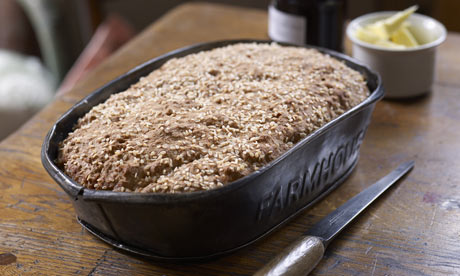
My success with the white yeast loaves last week emboldened me to try my hand at this recipe, which uses treacle to speed up the yeast. It creates a very wet dough, and takes a total of 90 minutes to make, including 20 minutes rising time and an hour in the oven.
The main stumbling block was that the recipe calls for a tin 5 inches by 8. I don't have anything even close to this in my vast collection of baking tins.
In my first effort, I used two 1 lb loaf tins, and I think I didn't let the yeast brew or the dough rise for long enough, because I ended up with two aromatic but totally solid bricks of bread.
Undaunted (or at least not very daunted) I tried again, taking more care to give the yeast a chance and using a square tin usually used for Christmas cake.
This was much more satisfactory, even though the crust is still vaguely reminiscent of Storm Troopers' armour. At least the crumb is soft and completely cooked and tastes nice.
The other difference between the first two was the flour I used. The recipe calls for 450 g of wholemeal flour, or 7 parts brown flour to one of strong white. I used all strong flour, brown and white the first time, and the second time, I used 3 parts strong brown flour to one of plain white. (I'm trying to use up the strong brown, which got substituted into an internet grocery order).
I'm hoping that a few more attempts (and possibly some plain brown flour) will see me producing bread worth keeping in a drawer.

Wednesday, April 07, 2010

Have a heart!

Growing up, artichokes were always seen as a great treat in my family. It only occurs to me now that there may be some link with the fact that they are a perfect excuse for eating lakes of melted butter.
The ritual of pulling off the individual leaves, dipping their fat bottoms in butter and scraping off the flesh with your teeth (among my gap-toothed family, there was much comparison of the different toothmarks possible); the leaves getting thinner and softer until you could pull them off in hanks; the moment at which you gave up on the leaves to pull off what remained in order to get to the tricky task of removing the choke - if you get it perfectly right, it pulls away leaving the dimpled surface of the heart intact - in order to get to the heart of the matter, which was then itself dipped in the remaining puddle of melted butter; savouring the strangely changed taste of water drunk with the flavour of artichoke on your tongue; all of this was pure joy.
Occasionally we visited the only other family we knew who ate these bizarre, prickly beasts and then we had to keep quiet while they told us at length about how wonderful their artichoke dipping sauces was. Made with red wine, it was nice enough, but we always exchanged glances over the table and yearned for our own melted butter.
As a teenager I introduced a friend to our homegrown artichokes, helping her through the elaborate ritual. Finally, I sat back, waiting for her cries of joy and gratitude.
"It's a lot of work, isn't it?" was her only comment.
The importance of this ritual, along with an Irish Protestant aversion to waste, means I was never able to follow any recipe that required only the heart of the artichoke - the idea of throwing away all the leaves is shocking.
But luckily, I have discovered that for some things, tinned artichoke hearts are perfectly acceptable. Although I probably wouldn't use them for a dish where they had to sit whole and beautiful, they make very nice (and instant) dip.
Just drain and purée a tin of artichoke hearts with some crushed garlic, lemon juice and lots of olive oil, season and serve with a slick of olive oil on top, perhaps with some chopped parsley or basil, or a sprinkle of paprika, to liven up the dull beige appearance, and you have a delicious dip to accompany an aperitif.
Just remember not to serve it with wine.

Saturday, October 03, 2009

Spaghetti? Squash?

One of the things I love most about food is how magic it is. Most of this is the kind of chemistry that happens when you boil an egg - clear liquid goo goes solid and white. When you add flour to melted butter and it forms a runny sauce, then you add liquid and it solidifies. You put cake batter into the oven and it disappears, leaving a cake in its place.

This is all magic where it feels like you, the cook, are the conjuror. You are the agent of the magic.

But even better is the magic the food has inside itself. One of my favourite examples is rarely available on this side of the Atlantic. It looks like a normal squash - big, round, a bit dull. You cut it in half - same story. Scoop out the seeds and bake or steam the squash as you normally would.

Then - ABRACADABRA and Hey Presto! - use a fork to scrape out the flesh of your boring yellow squash, which turns into noodles. Like so:

This is the spaghetti squash tossed with butter, cheese and basil leaves. No pasta involved.

Even the Man, who had traumatic memories of being forcefed spaghetti squash in a Winnebago overlooking the Grand Canyon age 10 admitted grudgingly that it wasn't as awful as he had expected.

Which is high praise.

I took the leftovers to work as my packed lunch the next day and was delighted to discover that it was genuinely nice, not just exciting because it's so weird.

Thursday, September 24, 2009

The Scent of Melons

I have often wondered why there aren't more positive words for smells. There are lots of unpleasant words - stench, stink, mephitic, acrid, putrid - a few neutral or context-specific - pungent, earthy, sharp - and a handful of not very specific pleasant ones, such as aromatic and fragrant.
This is in spite of the power of smell to make us happy, to trigger memories, to influence us. People trying to sell or rent their houses are told to have a pot of coffee on the stove to make prospective buyers like the place more. Supermarkets are said to pump artificial fresh-bread-smell out to make shoppers feel hungry and make the place more appealing.
One sniff of fresh blackcurrant cordial and I'm back in my grandmother's kitchen, while the smell of hay transports me back to my childhood, hot and happy summer days bringing in the hay.
And walking past the fruit and veg section of our local Turkish shop the other day, I was seized by a scent of the most extraordinary beauty. It was a ripe Galia melon, which I bought and took home to put where I usually put a vase of flowers, and it filled the room with its sweet, soft, cool smell.

Thursday, April 23, 2009

Granny Cooked


When my cousin Thomas was small, our mutual grandmother was concerned he was eating too much junk food. As a moral lesson, she trained her Pekinese dogs to do a new trick. You put a piece of food (they particularly liked bits of Victoria sponge) in front of them and said 'Junk food'. They would sneer. 'Crisps' - the same reaction. 'Burgers', 'chicken nuggets', 'chips' or 'biscuits' would all be scorned by Bangs or Azalea.
Then before the poor beast starved to death in front of your eyes, you would say 'Granny Cooked!' and the dog would gobble up the finally licit morsel.
I'm not sure Thomas really took this to heart as a lesson (although he is now a very devoted organic gardener and disciple of Hugh Fearnley-Whittingstall), but I was much impressed.
Granny Cooked notwithstanding, there are certain convenience foods I still find irresistable.
Hash browns, curly fries, waffles - there's a processed potato theme here, I realise.
I have started stocking hash browns in the freezer for the Kitchen Accomplice when she gets in from school.
This week i also invested in Toastabags, thinking they would be good for preparing hash browns.
But when I asked how it had gone, the young lady said cooking them from frozen was quite demanding.
"The toaster had to be popped like 1200 hundred times just to defrost them. So then I put them in the microwave. And then I fried them." By then, I guess, she was certain they were dead, so she ate them.

Tuesday, March 10, 2009

The romantic associations of tea-bread

I'm normally a staunch member of the 'Down with Raisins' fraternity, but there is one exception. Tea bread, which is really cake made with raisins soaked in tea, somehow persuades me it is acceptable. Perhaps this is something to do with having been introduced to it by a very close friend when a teenager - not a boyfriend (always so much less romantic than the imagination), but a boy nevertheless.

For years I carried his recipe for tea bread, written in his characteristically spiky handwriting, in my wallet. It was very slightly more complex than the one I use now, but came out very well too.

My current recipe has the beauty of extreme simplicity.

2 mugs dried fruit
1 mug brown sugar
1 mug hot black tea
1 egg
1 mug self-raising flour.

Soak the fruit and sugar overnight in the tea, mix in the egg and flour, pour into a greased and lined loaf tin and bake at 150 C, gas mark 2, for an hour and a half.

Unable to leave well alone, I add some pinches of spice - cinnamon and clove, even a pinch of star anise I ground earlier - but this is entirely optional.

The important thing is to serve it in thickly buttered slices. Yum!

Tuesday, July 29, 2008

Peaches and cream


Growing up with American children’s books, I have an image of fruit pies as the epitome of healthful plenty. Peach pie, apple pie, blueberry pie. They must have beautiful golden crusts, possibly with latticed tops and come with thick cream. Ideally they are made with fruit that you have picked yourself, and obviously they must be made by a plump and smiling housewife.

I had never eaten such a thing - apart from apple pie, my mother only made fruit tarts, and always with horrible short pastry - until last week.

Staying at the in-laws for the weekend, they had gone out, the Man was asleep or working on his computer or similarly unavailable, the young lady and myself decided to amuse ourselves by baking something.

This is one of my favourite games - get out the cookbooks and find something that sounds delicious but you’ve never eaten and then make it.

This time I’d brought my copy of the Joy of Cooking with me, so we just looked in that. After a lot of discussion of what we were capable of/equipped to do/liked the look of, we settled on Peach and Raspberry Pie with Flaky Cream Cheese Pastry.

The pastry is very easy (I think the cream cheese really makes it much easier) and if you have a freezer to hand, it’s not so important to have cold hands.

Flaky Cream Cheese Pastry:
1 cup plus 2 tbsp flour
1 tbsp white sugar
1/4 tsp salt
3 oz butter (75g) (diced and put in the freezer for ten minutes)
3 oz cream cheese (75g) (also put in the freezer for ten minutes)
2-3 tbsp iced water (or cream, if you worry that it won’t be rich enough)

Whisk the dry ingredients and then cut in the fat until the mixture resembles coarse crumbs with some pea-sized ingredients. This is not the moment to get over-precise - you actually want there to be unevenly sized lumps, because that’s what makes it flaky.
Add the liquid very slowly and cut the dough with a spatula, just enough to bring the dough together in a lump.
Divide the dough into two not quite even lumps, shape into discs, wrap in clingfilm and put them in the fridge for at least an hour.

Then roll out the larger disc to around 13 inches and fit it into a 9-inch shallow pie dish or tart tin. Make sure to leave at least 3/4 of an inch overhang all round, and trim it neatly. Put it back in the fridge.

Now for the pie lid. Roll out the other disc of dough to around 12 inches and either put it back to chill again or start doing basket work with it. We went fancy and made it into woven lattice, which turned out to be a lot less work (although quite time-consuming) than you might think. Instructions can be found here.

Make the lattice on a little tray or something, so that you can put it into the freezer to stiffen while you make the filling.

Filling
10 peaches, peeled and slice
2 cups raspberries (you’re aiming for around 5 cups of fruit altogether)
3/4 cup sugar
3 1/2 tbsp cornflour
3 tbsp lemon juice
1/4 tsp almond extract (optional)
Large pinch of salt

Mix it all together and let stand for 15 minutes. At this point, you should turn the oven on to heat to 220°C.

Now stick it in the pie, place the lid carefully on top and bring the edges of the lower crust over to hold it in place, pinching it firmly. If you haven’t made a lattice, remember to cut steam vents.

Brush the lid with milk and scatter a wee bit of sugar over it to make it pretty.

Put it in the oven for half an hour, then turn the heat down to 180°C, slip a baking tray underneath it and bake for another 25-35 minutes, until the fruit is bubbling up.

Let it cool before eating it - fruit and sugar get pretty hot!

Sunday, October 28, 2007

Cheese Dreams

When I was little, we often used to have melted cheese on toast, which we called Cheese Dreams. There is a smidgin of truth in the theory that cheese gives you nightmares: apparently eating cheese just before going to sleep can increase your amount of REM sleep, during which you dream. This does not alter the proportions of normal dreams to nightmares, but if you are prone to bad dreams, they are presumably more likely to happen after eating cheese. If you usually have harmless or enjoyable dreams, eating cheese before bed seems like a good idea.

Wednesday, October 18, 2006

Turkey twizzlers? I don't think so!

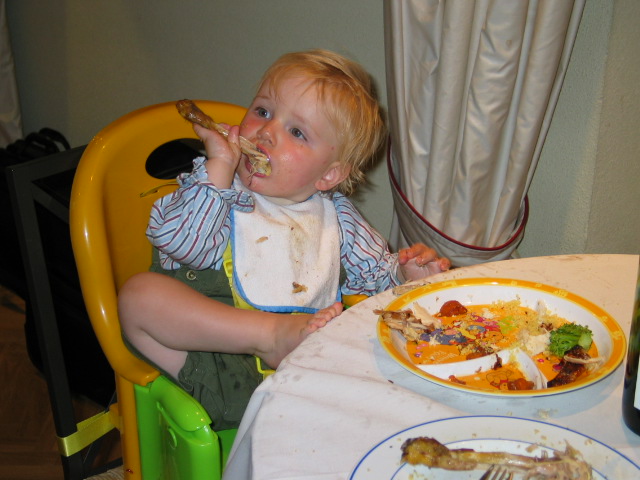
I had all sorts of clever and profound things to say about the importance of introducing children to good food early on. I was also planning to boast about my friend who devoted a large amount of her maternity leave to steaming and puréeing organic fruit and vegetables, then freezing them in ice-cube trays so that Baby Louis would be able to have gourmet mixtures at every meal (apparently six veg-cubes constituted a meal). But in the end, the picture of Louis, now liberated from the strict vegetable diet, enjoying a hearty gnaw, speaks for itself.
This is how to enjoy food!