For a year as a difficult teenager, I lived in the house of my godmother, her husband and their three children. It's a lovely house - a huge Victorian end of terrace monstrosity, painted pink, in the Dublin seaside suburb of Dun Laoghaire.
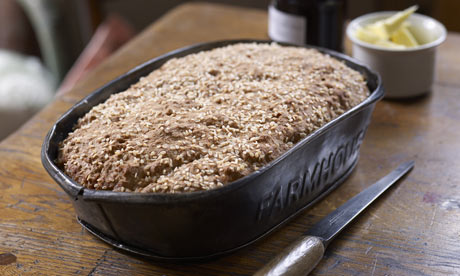
One of the nicest things about it was the biggest kitchen I've ever been in, with lovely dark green cupboards and units lining one wall. Next to the sink were some drawers - if you opened the second drawer down, you found the bread board, the bread knife and the bread. This was always the same, huge flattish round loaves made by Michael from Darina Allen's no-knead recipe.
My success with the white yeast loaves last week emboldened me to try my hand at this recipe, which uses treacle to speed up the yeast. It creates a very wet dough, and takes a total of 90 minutes to make, including 20 minutes rising time and an hour in the oven.
The main stumbling block was that the recipe calls for a tin 5 inches by 8. I don't have anything even close to this in my vast collection of baking tins.
In my first effort, I used two 1 lb loaf tins, and I think I didn't let the yeast brew or the dough rise for long enough, because I ended up with two aromatic but totally solid bricks of bread.
Undaunted (or at least not very daunted) I tried again, taking more care to give the yeast a chance and using a square tin usually used for Christmas cake.
This was much more satisfactory, even though the crust is still vaguely reminiscent of Storm Troopers' armour. At least the crumb is soft and completely cooked and tastes nice.
The other difference between the first two was the flour I used. The recipe calls for 450 g of wholemeal flour, or 7 parts brown flour to one of strong white. I used all strong flour, brown and white the first time, and the second time, I used 3 parts strong brown flour to one of plain white. (I'm trying to use up the strong brown, which got substituted into an internet grocery order).
I'm hoping that a few more attempts (and possibly some plain brown flour) will see me producing bread worth keeping in a drawer.
Showing posts with label bread. Show all posts
Thursday, April 29, 2010
Saturday, April 17, 2010
See how they rise up!
Yeast bread has always eluded me - the dough fails to rise and it comes out inedibly tough. My lovely friends have on occasion choked down leaden loaves, pretending they're impressed, but you can't pretend an indigestible lump of undercooked dough is really bread.This time, however, was different. I used fresh yeast, strong flour and a Darina Allen recipe, spent twelve minutes by the clock kneading it and left it to rise in a sunny kitchen, while I went and sorted through the letters I received as a teenager (long story).
After proving, knocking back, proving, putting in oiled tins and allowing the dough to rise for an extra ten minutes, I put them in the magic new oven on the Automatic Bread Setting. Fifty-five minutes later, I had two beautiful golden loaves of bread.
The Man and I have spent the rest of the afternoon sneaking into the kitchen and cutting ourselves slices of delicious soft light bread.
I have cracked the secret of yeast bread. My next plan is to get a system in place where I have pizza dough in the freezer for making after school suppers for the Kitchen Accomplice.
Monday, October 16, 2006
Irregular verbs
Have you ever noticed that, in languages other than the irrepressibly irregular English, it is the most commonly used verbs that are least regular? To a student, this can seem like a willfully excluding trait, putting the highest hurdle first; but of course it is perfectly understandable that the words that are most used are those that get rubbed into different shapes. Those shapes may seem unreasonable to the outsider, but they are comfortingly familiar to native speakers.
In the same way, it is the basic building blocks of a cuisine, universally used and often ignored, that are hardest to replicate in another country.
Everyone knows that the Irish are fussy about potatoes, so no-one is surprised when I lament the lack of ‘balls of flour’ in English greengrocers, but even I am taken aback by how much I still miss Irish bread. Not the brown (soda) bread that I could make for myself or even buy by going to the right London supermarket, but plain old Irish sliced pan.
After years of vague disappointment every time I had toast (Kerrygold butter is available here, so I knew that wasn’t the problem) I identified the issue: it wasn’t chewy enough.
I don’t know if it’s because of the damper climate, which might affect either the wheat itself or the rising process, but Irish bread is almost without exception chewier than its English equivalent.
It’s not necessarily better, but it’s how I like it. The glutinous verb of chewing bread is familiar to me and anything else tastes like a foreigner saying “I goed” instead of “I went”.
Even grand organic freshly baked bread is usually less chewy than I want it to be, but I have finally found a source of bread that is delightfully tough, although packed with flavour.
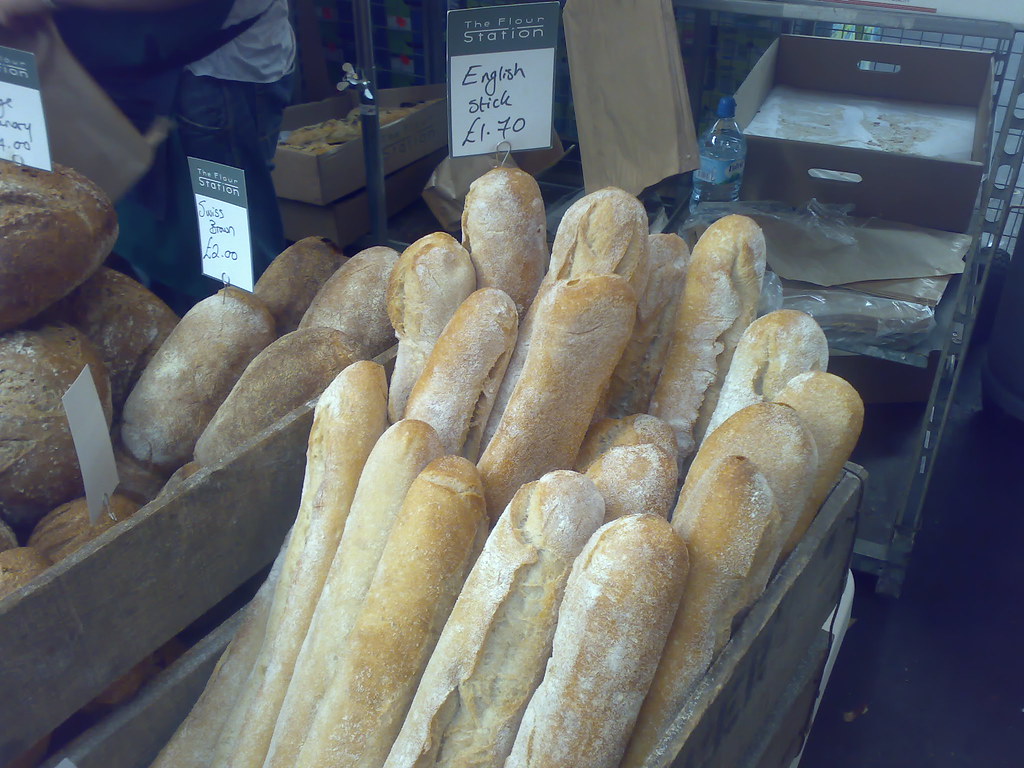
The Flour Station now has a weekly stall on Borough Market, where the staff are unfriendly until you show an active interest in their bread, at which point they open up and tell you in detail about their lengthy proving, the importance of the ingredients and how they are treated and how to look after the bread they are selling you. Apparently the difference is that any loaf of bread you buy from them has taken nearly 24 hours to reach its farinaceous apotheosis, which gives the gluten time to develop. Last week I spoke to a relatively junior assistant, who told me to come back when his boss was there to explain the science behind it. I plan to spend the intervening time reading Harold McGee’s account of bread-making, so as to be able to ask intelligent questions. In the meantime, I will live on the memory of the country levain, the English stick and even the olive-oil laden focaccia.
In the same way, it is the basic building blocks of a cuisine, universally used and often ignored, that are hardest to replicate in another country.
Everyone knows that the Irish are fussy about potatoes, so no-one is surprised when I lament the lack of ‘balls of flour’ in English greengrocers, but even I am taken aback by how much I still miss Irish bread. Not the brown (soda) bread that I could make for myself or even buy by going to the right London supermarket, but plain old Irish sliced pan.
After years of vague disappointment every time I had toast (Kerrygold butter is available here, so I knew that wasn’t the problem) I identified the issue: it wasn’t chewy enough.
I don’t know if it’s because of the damper climate, which might affect either the wheat itself or the rising process, but Irish bread is almost without exception chewier than its English equivalent.
It’s not necessarily better, but it’s how I like it. The glutinous verb of chewing bread is familiar to me and anything else tastes like a foreigner saying “I goed” instead of “I went”.
Even grand organic freshly baked bread is usually less chewy than I want it to be, but I have finally found a source of bread that is delightfully tough, although packed with flavour.
Subscribe to:
Posts (Atom)