Search This Blog

Saturday, September 16, 2006

The scent of apples


As a devotee of heritage apple varieties - and no one is more delighted than I am when the fragrant boxes start to appear at farmers' markets and outside Neal's Yard Dairy - I am supposed to despise Golden Delicious, Granny Smith, Pink Lady and other such plastic-bag-packed, supermarket waxed, varieties.
But outside of September and November, when I spend most of my time crunching on Norfolk Russets or Nutmeg Pippins, I do occasionally have a yen for a soft, sweet-scented Golden Delicious, spraying sugary juice as you bite into it, or a crisp, plastic-skinned Granny Smith, whose acid flesh was always paired in my adolescent midnight snacks with processed red cheddar. Pink Ladies are a more recent introduction and so have no childhood memories to soften my perception that they are a scary apple clone, intended to satisfy the minimum requirements of an apple and therefore quell our desire for the wild and inefficient variety of oddly sized, differingly flavoured, sometimes scabby or misshapen apples that are the natural heritage of anyone brought up in the temperate climes of north-west Europe.

Thursday, September 14, 2006

Oooh saucy!

I have eaten in a couple of fantastic restaurants recently where excellent service and imaginatively used ingredients were undermined by a failure to balance the main ingredient with the sauce. At Zuma, a seaweed salad came drenched in a tahini sauce that not only beat the subtle flavour of the sea vegetable into submission, but left the succulent, rubbery texture bedraggled and unattractive.
The signature dish of marinated black cod wrapped in hoba leaf, while obviously the finest fish you could wish for, was again overpowered by a sweetish sauce that simply did not give the fish room to express itself. Mixing rice into the sauce did lighten the mixture so that one could see the point, but given the way the menu was set out (very Atkins friendly), it would have been easy not to order any carbohydrate at all.
I should say that the sashimi was delicious, the soft-shell crab with wasabi mayonnaise dreamy and the service assiduous without being intrusive. My notes say that we also had grilled tuna with barbecue sauce and grilled chillies. I remember the tuna (fish that good is hard to forget), but the barbecue sauce has passed from my memory and is not visible anywhere on the menu.
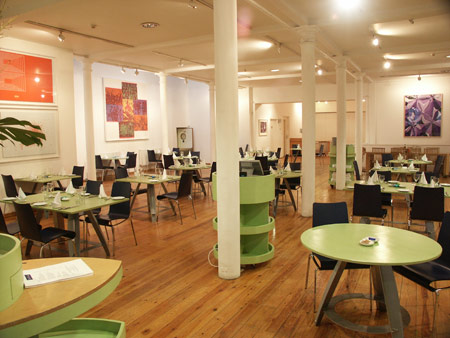
Lunch today at Café Studio Delfina (pictured) was as delightful as I have come to expect from this interesting outpost of culture, both visual and culinary, behind London Bridge. The starter of tempura Monte Enebro goat's cheese drizzled with lavender honey and almond nibs next to a salad of bitter leaves was beautifully judged. The balance between unctuous and delicate, salty and sweet, lush and bitter, brought all the ingredients together in a complex system of flavour and mouthfeel.
However, the lemon sole with strawberry and Thai herb sauce, served with rice, displayed the same failing as the Zuma dishes. Excellent ingredients, thoughtfully combined (the sweetness of the strawberry sauce was beautifully cut by the anise of the Thai basil), were just in the wrong proportions. The delicate sole was swamped in the bright pink gravy, both texture and flavour dampened by too much sauce.
At least this time rice came as part of the deal, but it was served in a bowl alongside, consisting of fat, undersalted grains, failing to fully serve its purpose as a soaker-up of unnecessary sauce.
A friend of mine has accused me of being anti-sauce, but I'm confident this is not the case. As a devotee of French cuisine, I am sometimes even concerned that I am too much given to smothering my food with sauce, but I do try to make sure that the underlying component can stand up to the overlay. Perhaps I just need to prioritise the carbohydrates on my restaurant plate - or perhaps fashionable chefs need to spend more time thinking about the structure of their dishes as eaten by the customers, instead of concerning themselves only with the checklist of flavours.

Wednesday, September 13, 2006

A friend in need makes pie


What's the best way to be a supportive friend? When a distressed pianist rang me up to say that the female pianist he had been seeing had severed relations (because she liked him too much. This is typical of musician-logic. Never get involved emotionally with a musician!), I naturally offered the most comforting response I could think of.
"Come and have a drink, and then let's cook supper together."
Luckily I had spent the afternoon experimenting with my pastry-making abilities; I've never liked short pastry but have always assumed that flaky pastry was both too difficult and too arduous for me to make. A Darina Allen recipe that promised infallible results provided the instructions were followed meticulously, combined with an empty Sunday afternoon, had inspired me, so a beautiful pat of raw flaky pastry was resting in my fridge, just right for providing aid and succour to heartbroken keyboardists.
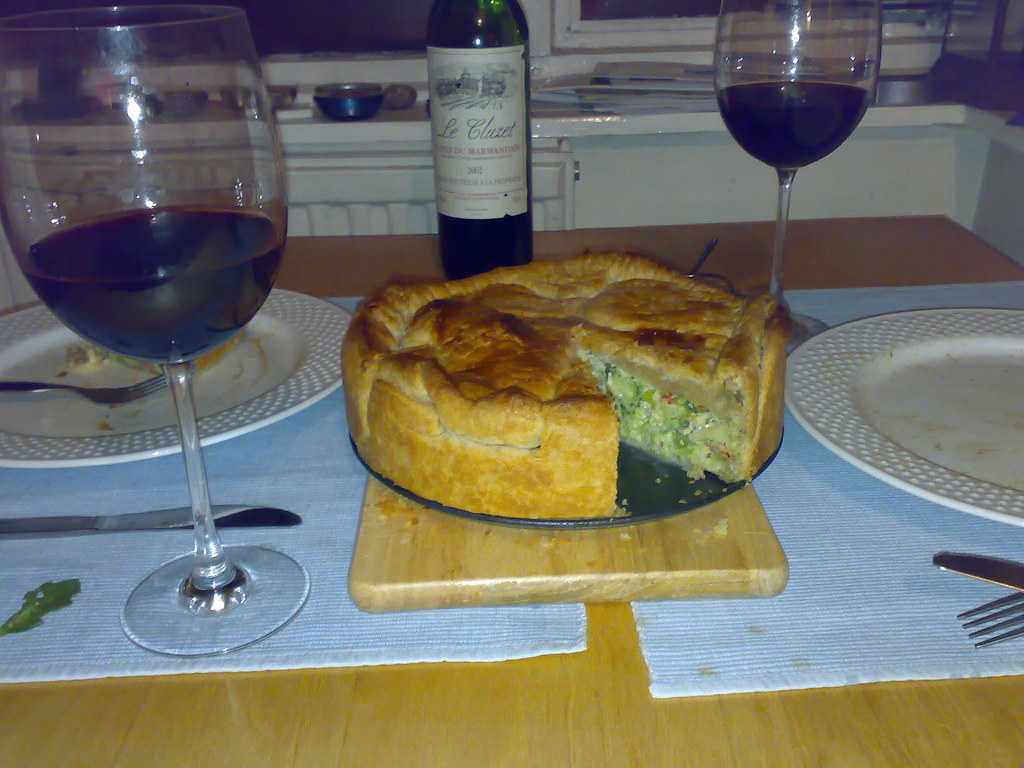
We didn't follow a recipe for the filling (although we did glance at a couple of Nigella recipes for inspiration), but relied heavily on the contents of the musical fridge. The fridge and the local Turkish convenience store provided the ingredients for a broccoli, bacon and cheese pie, with red chilli to add zing visually and orally, and an egg to hold it all together.
Add some salad and red wine and it certainly softened the blow of being dumped.
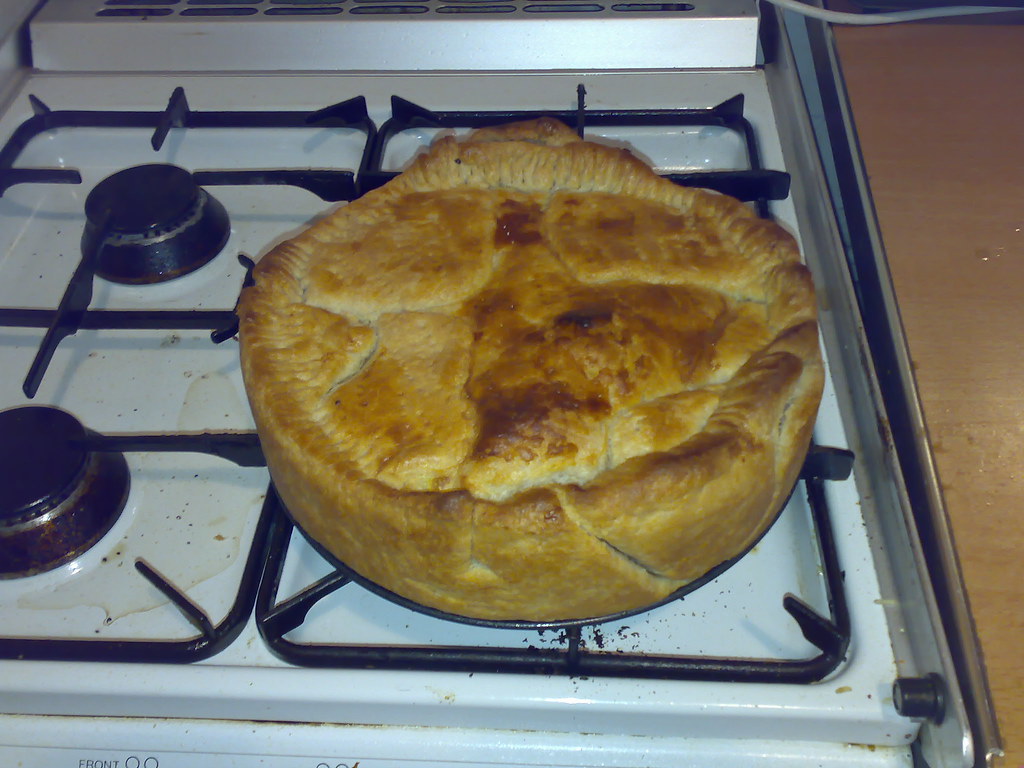
Technical notes: I used unsalted butter in the pastry, which was a mistake as it left the pastry a little bit bland, and I was too proud of my pastry to bring myself to trim it properly - hence the odd triangles folded over the top of the pie. That was another mistake, as it left undercooked wodges of pastry under the triangles. I'll know better for next time.

Tuesday, September 12, 2006

Birthday cake blog


You already know the recipe , so let's be specific about the baking of this particular cake.
I arrived home last night, confident that I had all the ingredients for Granny Grene Chocolate Cake, which I needed to prepare for this morning. My plan was clear and achievable: make the cake, put it in the oven, spend 20-25 minutes pottering over some chores, take the cake out of the oven and go to bed well before midnight. This would have made it easy to get up early, ice the cake and deliver it before going to work.
This all went swimmingly until it came time to measure out the flour and cocoa . I knew for a fact that I owned (in the sense of paid for and have not yet used) 1 1/2 small pots of Green & Black's Cocoa , and a large pot of supermarket own brand cocoa. Unfortunately I had not bothered to pack them in the last move, so they are all sitting in a kitchen cupboard in Chelsea, an hour's bike ride away.
NO COCOA!
Not a disaster. Put jeans on instead of pyjama bottoms, hop on bike, up to late night shop. Nearest LNS closed; go to the next one. Next two also closed. Head down Green Lanes (a lively or dangerous road, depending on your sense of adventure) to the 24-hour convenience store. First one: no cocoa. Second one: five different varieties of drinking chocolate, still no cocoa.
Back on the bike to get to another shop - this one I'm confident will provide.
But the nice police constable politely asks me to wait while the police photograph the crime scene between me and the final shop. Finally traffic is allowed through and I gingerly cycle past, not liking to stop and peer at what I think are bloodsoaked rags behind the police incident tape.
The last shop has cocoa!
Invigorated by my success, I zoom home to complete the interrupted baking.
After this adventure, it scarcely seems worth commenting on the actual baking, icing, decorating and eating of the cake. I would just like to say that my fan oven, which up till now I have found unsatisfactory, seems to bake cake beautifully.
Happy birthday, Jack!

Monday, September 11, 2006

How to stay thin and maintain your foodie status

What makes a diet successful, if you discount any of the pseudo-scientific babble about blood-groups, star signs, or the evolution of our digestive tracts? A successful diet gives its followers a framework for eating less, allows them to spend their entire time thinking about food and gets them to consume fewer calories.
Unlike most fashionable diets, my favoured method of staying thin has no claim to be backed by any scientific theory (although if pressed, I could probably come up with some improvisation about it using the principles of cognitive behaviour therapy). But it does allow, or rather command, you to eat delicious food.
The principle is that any food you eat should be delicious. It works if you concede a number of underlying assumptions: freshly prepared food is better; seasonal food (often organic) tastes nicer; with most foodstuffs, if you pay more you get better quality. Most importantly, once you have eaten more than a small amount, even caviar will slip from the pinnacle of deliciousness to being just very nice fish jam. The one thing forbidden by this diet is excess of quantity.
With this diet, you can eat whatever you like, whether it be foie gras or fried egg sandwiches, provided it is truly delicious. There are several ways in which this guards against over-consumption. First of all, you can’t afford to eat enormous amounts, because even a frugal-seeming plate of antipasto for two can blow a week’s budget if you’re buying the very best San Daniele prosciutto and marinated artichoke hearts.
Then, you will spend so much time choosing and preparing the food that you will have less time to munch as distraction from being bored.
Both of these factors are limiting in themselves, but they will also result in your having a more respectful attitude to the food that has cost you such an effort. You will appreciate it more, savour the flavours more carefully and eat less for more pleasure.
The only danger is that you become obsessed and start spending your time doing things like making flaky pastry or stuffing almonds into olives. Life is full of risks.

Sunday, September 10, 2006

Fear of fish


Every fish recipe you’ve ever read tells you how easy it is to cook fish. So why do I find it so hard? Even buying fish is difficult - there is so much choice (I’m never good with choice) and they don’t come with instructions. I often go to the fishmongers with the best of intentions and then come over all funny at the thought of coming to terms with red mullet or line-caught wild seabass, and have to run away to the butcher instead.
Having bought the fish, the next step is to find a recipe. This I also find intimidating, because they always tell me how easy and simple it’s going to be.
I never trust anyone or anything who tell me something will be easy. That just means that when it goes wrong, it will be for some unidentifiable but fundamental reason that is probably caused by my having bad karma. A complicated recipe is more likely to come out edible, because getting one step wrong (or forgetting it entirely - that happens often) is unlikely to spoil the whole thing.
Last week I tried a Nigella recipe for mackerel poached in cider; although it wasn’t inedible, it did end up overcooked and certainly not worth the effort I put into it.
Sometimes I wonder if the reason I can’t cook fish is that I don’t like fish. It’s certainly true that I am never tempted by the idea - my food fantasies are usually based on meat or cheese - but many of the best meals I have ever had in restaurants have been fish.
In attempt to get over this block, I will spend a day learning to face my fishy fears at the Billingsgate Seafood Training School . After this, I will either be capable of producing delicious fish or confident enough to say that I just don’t like eating things without legs.

Saturday, September 09, 2006

Back or streaky?


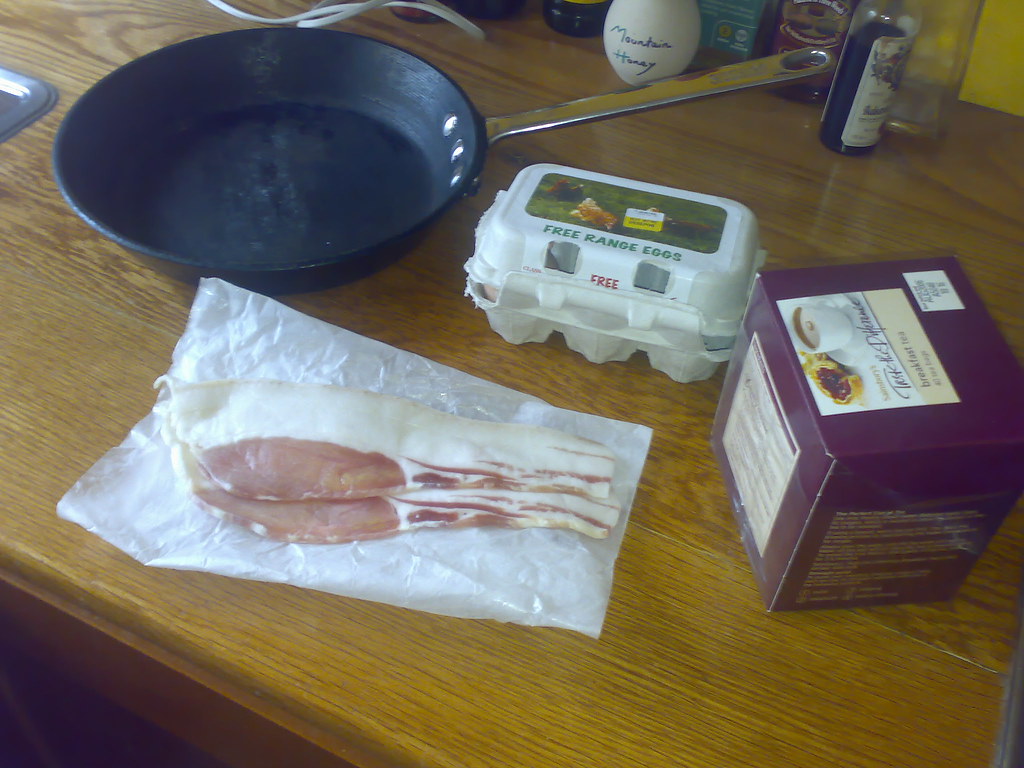
Shouldn't bacon be streaky and smoked for maximum flavour? Until this morning, that was my belief. Then the Man cooked me breakfast with this bacon taken from the backs of happy Gloucester Old Spot pigs, with a layer of white fat significantly thicker than the meat.
He cooked it very gently so there was just a barely golden surface slipping off the fat, and accompanied it with entirely unncessary (but very nice) fried eggs.
The first mouthful did not appeal, because it was very different from my idea of bacon, but by half-way through the second mouthful, I understood and was in awe. The mouthfeel is extraordinary - light greasiness wrapping the subtle crunch of the unmelted fat - and the flavour required no smoking, no added sweetness. It was savoury without being salty, subtle without being elusive.

Tuesday, August 29, 2006

heaven in small bites

People may complain (and they frequently do) that Brussels is not the most exciting city in Europe, but nobody could complain that it doesn’t have good restaurants.
Not only do even the small neighbourhood brasseries have excellent standards (I still regularly recreate a warm chocolate and cinnamon soup from one), but there is no lack of innovation and creativity in serving styles.
Although the ‘tapas-style’ or grazing menu has made its insistent way across the continent, it is not necessarily an easy one to get right. The temptation is to have too long a list of little things, so that the attention to detail that is key to making each individual dish different and satisfying is lost. In restaurants that avoid this pitfall, there is the danger that the ingredients and artistry required push the price up to the point that you end up paying huge amounts for tiny nibbles.
Le Fourneau managed to steer its way carefully between this Scylla and Charybdis, with just 15 principal dishes, four ‘indispensable’ and six ‘superflus’, although it’s hard to know by what scale of values haricot coco and potato with truffles is indispensable while a salad of baby spinach leaves is superfluous.
Everything comes either by weight (100g seems the base measure for things like fish or steak) or single units of itself, such as the lobster raviole.
Predisposed to like it simply because it was prepared to serve us ten minutes before the kitchen was due to close (three other restaurants had already turned us away - Belgian chefs like to go off duty at 9.30pm, and who shall blame them?), my companion and I were very taken with the high stools ranged along a bar surrounding a central table and viewing the kitchen. I would not care to sit at that central table myself, but it provided much entertainment after the chef had finally cooked his last bonne bouche.
A restaurant so expensively and minimally decorated in London would also be intimidatingly trendy. In Brussels the staff were of the highest competence but extremely friendly and helpful.
An amuse gueule of mousse de foie gras with quail was much lighter and less meaty than the description sounds, more like a savoury dessert in the mouth. My companion and I, having fought like sulky siblings over who got to order the best dishes, had a lobster raviole apiece, swimming delightfully in its cream sauce. This is the kind of dish that eaten in conventional quantities might give rise to nightmares, but in a portion that can be comfortably consumed in four forkfuls leaves one regretful that it is so small but ready to move on to turbot in butter sauce (heavenly) and carpaccio of tuna with mango (excellent but not as sybaritic as the other dishes). The only element that failed to strike a similarly high note was the papillote of langoustine with Thai basil, which came across as a half-hearted spring roll, minus the usual crispness of the vegetables.
This I supplemented with a perfect salad in petto, miniature little gem leaves with tiny bacon bits and croutons, leaving me ready to contemplate the dessert menu with much more than my usual enthusiasm.
The menu well repaid my interest, offering up a ‘panaché’ or smorgasbrod of delights. Melon soup, chocolate mousse, almond milk ice-cream and raspberry sorbet chased each other around my palate, spoonful by spoonful daring me to choose which combination I liked best.
The rich velvety darkness of the chocolate mousse was offset by the bitter cold of the almond ice-cream , while the clean sweetness of the melon balanced the tartness of the raspberry sorbet. Just another taste of chocolate to see how that goes with the raspberry, perhaps; although maybe the watery flavour melon would complement the thickness of the mousse. Another spoonful of bitter almonds to remind me of the scent of English 1920s murder mysteries… How can the raspberry sorbet taste so intensely of raspberries? And how can it all be gone already?
I was filled with envy of my companion who lives in Brussels and can go there every week if he so wishes, to discover what is so indispensable about ‘gateau de legumes, envie de soleil’ (does this mean that the vegetable cake sits on your plate, pining for the sun, or perhaps the sun is jealous of their summerry flavour?). When he actually told me about his next visit, when he inveigled his way far enough into the good books of the chef that the entire evening was spent accepting little offerings the chef had thought might tempt his palate, I turned green and started to lay plans to move to Brussels.

Friday, August 25, 2006

Serving suggestions, please

I work alongside a trade magazine for the drinks business. This means that there are often bizarre and wonderful beverages floating around the office, and occasionally I get offered a taste (although never of the vintage champagne, I've noticed!)

This afternoon, I was the only willing guinea-pig prepared to taste the chilli-flavoured beer. I had joined the general outcry of disgust when first told about it, but true to my principles was prepared to sip with an open mind.

The discoloured green chilli floating in it was not visually enticing, but it did augur well for the drink. This augury was not misleading, as it smelled and then tasted delightfully of fresh chillis, one of my favourite flavours. The next taste was just of a clean Mexican lager, and then finally a strong but not overpowering heat from the chilli.

My only problem with chilli beer is this: what would one drink it with? It's much too hot to drink with spicy food, but it would overpower most other meals. If I were ten years younger, I'd keep it in the fridge for drunken nights when I got home with a kebab, but I don't feel like going down that route any more.

Chocolate has a pleasing suitability, what with the Mexican connection, but I'm not sure what kind. Milk chocolate for the comfort and junk foodiness? Dark chocolate for cultural sensitivity?

Suggestions please!

Friday, July 21, 2006

Chicken noodle soup

[Note: this was supposed to be an apology for my refusal to back down and admit that I was wrong, but on mature reflection I have decided I was right, so it's a plea for forgiveness for being obnoxious instead.]

I am Jewish enough to think of chicken soup as a panacea for all ills, so when my Taste-tester had toothache, I rushed around armed with my pharmacopeia of chicken stock, noodles, chilli and coriander (I’m only Jewish through my paternal grandmother, which gives me leeway to make Thai-based chicken soup).
Despite pressure from the Taster to use reginette (wavy-edged, half-inch wide strips of pasta) I went with Sharwoods Egg Noodles, which I cooked according to instructions without salt. First mistake. Unsalted noodles are as uninteresting as any other unsalted pasta.
Then I assumed that the red chilli I had bought from Sainsburys would be very mild, so I chopped it all up and threw it into the stock at the very beginning. Second mistake. It was so spicy that I had to fish out most of it and add lots of lemon juice and fish sauce to tone down its fieriness.
The end result was not disastrous, but oddly unbalanced. It wasn’t too hot, but the lemon juice overwhelmed the delicate flavour of the stock, while the noodles were too bland to add any bite to the soup, which was also a bit salty in itself.
Because this was in the privacy of the Tester’s home (I am normally able to restrain myself from issuing searching critiques of my cooking when other people are eating it), I launched into an analysis of the problems and pondered the solutions.
I was enjoying myself, pontificating away as I considered the flavours in my mouth and imagined how they could be re-balanced, when the Taster jumped up and produced a book of noodle recipes for consultation.
For some reason, this eminently sensible action infuriated me, so I said scornful and illogical things about how pointless recipes were for such a simple dish, preached lofty ideals of allowing due weight to the sensory experience and ended up with almost a serious row on our hands.
His contention was that looking at other recipes would help me think about how I could improve my soup. I countered that it was futile to look at other people’s idea of what you should do with these simple ingredients in order to produce my own ideal. (Among other arguments against recipes that I won’t bore you with, and which anyway I would rather forget.)
In the calm light of day (and stuck in an oven-like office with only mind-numbingly dull work to do for the next couple of hours), I decided to be mature, climb down and look at alternative recipes for inspiration on how to improve my own technique.
And whaddayou know? The many recipes all aimed to achieve entirely different things with their chicken noodle soup, and were no help to me at all in thinking about my own recipe.

So here for the record is how I think I should have done it last night:

Chicken noodle broth for two

2 servings thin egg noodles
750ml chicken stock (I buy Joubere Organic stock when I don’t have enough of my own in the freezer)
a couple of scallions, chopped (reserve some of the green tips for garnish)
a stick of lemongrass, chopped into four cm lengths and bruised with the back of your knife
1 chicken breast, finely sliced
1 red chilli, sliced (and deseeded if necessary – the only way I know to find out if it is is to taste it, a risky strategy)
a squeeze of lemon juice
coriander, chopped

Boil some water, salt it generously and cook the noodles according to instructions. Meanwhile, put the stock, scallions and lemongrass into your soup pan and bring to a gentle boil. Add the chicken and cook till done, which should be only a few minutes. Just before it is done, add the chilli and the lemon juice, tasting to make sure you don’t overdo the lemon.
By this time the noodles are probably done. Strain them, refresh them in cold water and divide them between two soup bowls. Pour the broth over them, making sure the chicken gets shared out fairly. Add the chopped coriander and scallion tips as garnish.
Monday, July 17, 2006

Monaco - third circle of hell

I get no sympathy when I complain that I have to spend a week in Monaco for work, but believe me when I say it's horrible. Do you like crowds of loud rich people flaunting their yachts and their diamanté sunglasses, unbelievably high prices, a dearth of taxis and temperatures in the thirties? Then you would like Monaco.
I cordially dislike all of these things (and don't start me on the investment managers I was there to interview), so I don't care for the Principality. (And I am on principal opposed to royalty, so I don't like being in a place where there are photos of a singularly unappealing prince all over the place).
The positive side is the yearly press dinner held by a company that wisely chooses good restaurants and eschews talk about work in favour of jolly conversation. Last year it was held in the Chateau du Chevre d'Or, in a delightful village half an hour from Monaco. This year the venue was more convenient (being just on top of the conference centre) but still had fabulous views.
After a week of bright sunshine, the thunder was rumbling and the heavens had opened, so we couldn’t sit outside at Zebra Square, perched atop the Grimaldi Forum in Monaco. Luckily the excellent mojitos mixed up by the bar staff consoled us while the wait staff rushed around bringing in cushions from the terrace and preparing an indoor table for our party of 12.
I love restaurants that offer an amuse-bouche, a little something that the chef has come up with to keep you going (and amused!) while you decide on your meal, so I thought I was onto a winner when the waiter at Zebra Square produced and flourished a tray in front of us.
But we all did a massive double-take when we realised that the tray held two enormous fish (one dourade and one sea-bass), as well as a large lobster. One of my companions shrieked as the lobster waved a claw at us – this was the specials list.
Once we had been introduced to our food, we sat back and waited for the antipasto misto to appear. Bresaola and parmesan was excellent, although the chiffonade of parma ham was less than exciting (am I the only one who thinks Spanish jamon iberico is more than its equal?), as was the mozzarella and tomato salad. Making up for this was the pungent octupus salad and the fried calamari with a soy-based dip with an entirely unexpected chilli kick. All of these were served together on luxuriant beds of rocket, which got nibbled up as we awaited our main course.
None of us had been quite brave enough to demand the sacrifice of the friendly lobster, but my giant prawns were large enough to terrify a small child. With prawns, the rule is usually the smaller the sweeter, the larger the meatier. These were no exception, being very butch in flavour, but the rice and vegetables they came with did not live up to their company, being quiet and possibly subtle – next to the prawn monsters it was hard to tell.
Three of my companions had asked for the dourade to be served up between them, and it was reported to be delicious – it certainly smelt excellent – while no complaint was heard about the steak served variously rare and medium.
A couple of months ago, my low expectations of Italian cheese had been confounded by an excellent cheeseboard in a London restaurant, so Zebra Square’s ebullient waiter found it easy to persuade me that it was worth another try. Alas, my original opinion of Italian cheese – that it is soft and smooth and bland – was reinforced by the Taleggio, Dolcelatte and other unidentifiable smooth cheese that came in place of the promised Parmesan and Asiago.
Other diners claimed that their desserts (spiced pear compote, crème brulée, something chocolatey) were excellent. The final civilised touch came when the waiters cleared away the table cloth with the debris so we could sit over our coffee and liqueurs in comfort.
(Supporters of Italian cheese will be happy to hear that back in London, La Fromagerie supplied me with an excellent wine-washed Ubriaco that proves that Italy can produce something interesting other than Parmesan.)

Sunday, July 16, 2006

Coronation Chicken

I thought it might be interesting for some people to see the recipes from the menu at my mother’s birthday lunch:

In some circles, (middle English Daily Telegraph-reading classes, I believe) , Coronation Chicken is no longer acceptable because it is such a cliché for the buffet lunch, but it is my mother’s favourite party food, so the birthday girl had her way. It is also entirely possible that it has been resurrected in the way that prawn cocktails and melon balls have recently been. “Ironically” - you have to say it like that, making little quote marks with your fingers to emphasise how ironic it is. I assume it was invented in 1953 for the coronation of Queen Elizabeth II of the UK, but would be delighted to be put right.

This is the recipe my mother uses, as copied from her hand-written cookbook:

Coronation Chicken, (Rita Cassels)

Rice salad:
1 lb rice, cooked and dressed with olive oil and wine vinegar dressing while hot. I add frozen peas at this point, then sweetcorn, celery, peppers etc.


Coronation chicken:
1 cooked, chopped chicken.

Sauce:
2 onions
2 apples
3 tsp curry powder
2 tbsp apricot jam
1 glass red wine
bay leaf
150ml chicken stock
3 tbsp tomato purée

To add when cold:
1/2 pt cream, whipped
5 tablespoons mayonnaise

Fry onions, add other sauce ingredients and simmer 20 mins.
Cool and then stir in cream and mayonnaise and chicken.
Decorate with grapes and toasted almonds and serve on ring of rice salad.

For silent vegetarians

The vegetarian dish was an old standby of mine from years ago when I was less ambitious in the kitchen and had more vegetarian friends. It is from a Madhur Jaffreyy cookbook originally, but I was introduced to it by a very silent tutorial partner at university, who had devised several shortcuts. Years of experiment led me to the realisation that the times given were based on rather tougher versions of chickpeas and bulghur wheat than I usually use, so I have further tweaked the timings and added a couple of extra twiddles of my own.

Charlotte Smith’s bulghur wheat with chickpeas and tomatoes:

4 tbsp oil
1 onion, finely chopped
1 tin tomatoes
1 tin chickpeas, drained
1/2 tsp + 3/4 tsp salt
2 tbsp minced fresh parsley
1 cup bulghur wheat
lemon slices
more parsley to garnish

Heat the oil in a large pan with a tight-fitting lid. Fry the onions until soft, then add tomatoes and cook for 3-4 minutes. Add chickpeas, 1/2tsp salt and minced parsley, and cook for ten minutes on a low heat, stirring gently. Add bulghur wheat, 1 cup of water and 3/4 tsp salt. Stir and bring to a simmer. Cover, turn heat down very low and cook for 20 minutes. Turn off the flame, remove lid and cover pan wth a clean tea-towel. Replace lid and let sit for ten minutes. Stir in generous amounts of freshly ground black pepper and serve garnished with parsley and slices of lemon to squeeze over it.

Granny Grene Chocolate Cake

I have mentioned the inevitability of the Granny Grene Chocolate Cake as a birthday cake elsewhere, so here is the recipe, adapted for cupcakes. If you want to make a layer cake, use two 8 inch sandwich pans, bake for 35 minutes and use 4 ounces of butter as a base for the icing, which goes in the middle, on top and ROUND THE SIDES.
In any case, decorate with Smarties!

Please bear in mind that the recipe is American - measurements are given by volume and the cups are a bit smaller than European cups. I recommend investing a small amount in a Tala measure - I use mine all the time.

Granny Grene Chocolate Cake
Cupcake version

1/4 lb butter
1 cup sugar
2 eggs
1 1/3 cup plain flour
1/3 cup cocoa
1 2/3 tsp baking powder
pinch of salt
2/3 cup milk
1 tsp vanilla essence (optional)

Preheat the oven to gas mark 4, 350° C.
Cream the butter and sugar. Beat in eggs one at a time. Add dry ingredients, alternately with milk.
Put in bun cases - about one tablespoon of batter in each. Makes about 30 cupcakes.
Bake for approximately 20 minutes - or less, depending on your oven!

Chocolate butter icing:
Cream butter and caster sugar and add cocoa. Adjust amounts of cocoa and sugar to taste. You can add a liquid such as milk, cream, whiskey or whatever flavour you like.
I think about two and half or three ounces of butter is sufficient, then the amount of sugar and cocoa is entirely a matter of your own taste. You can substitute icing sugar for caster if you prefer smooth to crunchy icing.

Some people would recommend icing half the cupcakes with chocolate butter icing and the other half with orange butter icing, which is very simply butter and sugar creamed and flavoured with orange juice and a little orange zest.

Thursday, July 13, 2006

A big birthday lunch

A couple of weeks ago, my mother turned sixty. Although she has always been vague about her age, this has never been due to vanity (she is even more vague about her children’s ages), so she decided to hold a party for the occasion.
Naturally I saw this mostly as an opportunity to gain experience in catering for large numbers. The main problem was trying to find out how large those numbers were, and then to work out what the appropriate scale of catering would be.
My mother invited everyone she knew, or at least everyone whose contact details she had, but was very vague about how many that was and even more so about how many were likely to turn up. It turned out that our original guess of something between 100 and 120, based on a number of rules of thumb and a wild stab in the dark, was not bad - 128 plates were used for the main course.
What is the biggest number of people you have ever cooked for? Up to about 12 seems to work by regular maths, where the recipe gives a good enough guideline. After that, the law of large numbers apparently takes hold and people eat different amounts and expect different choices to be offered.
Amounts for the canapés to go with the champagne were easy enough to estimate, as most recipe books give guidelines (we went with three per person, which was not inadequate), but once you’re into the main course, guidance is hard to find.
We went the cold buffet route, laying food out on trestle tables in the barn (my parents still live on the farm where I grew up). There were three main course options: coronation chicken, which my mother made, mixing it up in a huge black bin purchased for the occasion, smoked trout fillets, and a vegetarian option. My parents, who are abstemious types themselves, assumed that everyone would choose one of these and take a reasonably small portion. Just half the hundred available trout fillets available were put out and I was instructed to keep the vegetarian option small. Since to my knowledge just one non-meat eater was expected, I merely made enough for twenty.
The four salads I made in slightly larger proportions - enough for perhaps thirty each - and my mother at the last minute decided that, as a special treat for herself, she would make egg mayonnaise. In the couple of days running up to the party, everyone kept trying to lighten her load by offering to make the mayonnaise, until she pointed out huffily that she enjoyed this particular task. Adventurously, she decided to trust Julia Child’s unlikely instruction that eggs may be hard-boiled in large quantities in a pressure cooker. This worked extremely well, with just one cracking in a dozen of dozens, although the egg yolks did discolour, despite Child’s assurances that they wouldn’t.
I’m sure any experienced caterer reading this will have worked out already that we were cutting the amounts very fine, especially given most people’s propensity, when faced with three main course options, to take some of each. Luckily I saw the one vegetarian standing in line just before the last portion of chickpeas was taken, so I jumped her to the head of the queue.
The next course of raspberries and cream was simplicity itself to serve, although again the amounts were not particularly generous. Cream does not get whipped up in a trice, so latecomers had to put up with pouring cream, while the extra meringues that we afterwards found hiding in a tin would probably also have been welcomed. Twenty pounds of raspberries disappeared in approximately 15 minutes, which implies that our guests were not only appreciative but also very efficient in serving themselves in the not particularly spacious room where we had set out dessert.
Cheese went down very well with those who found it, although this was the one area in which we over-catered (it is no coincidence that it was also the only area for which I was solely responsible). I have written in more detail about the cheese in a separate post!
Finally, there was birthday cake. In my family, birthday cake is practically by definition a chocolate cake made to my grandmother’s recipe and decorated with Smarties. The only concession I have made to advancing age is to make the cake into cupcakes, which I think are more elegant to serve and eat, as well as providing smaller portions for those of us who no longer want to stuff our faces to the point of nausea.
So for my mother’s sixtieth, it seemed appropriate to make sixty cupcakes, especially as she had rejected the idea of candles. Then of course I had to double that to ensure that every guest could have one if they so wished. One of my sisters arranged exactly sixty of them to form the digits 60, although as we are not a family that are good at ceremony or co-ordination, greedy guests were allowed to start eating them before we had a chance to have a proper embarassing communal singing of Happy Birthday and appreciating all my hard work!

Tuesday, July 11, 2006

Food you don't want to eat

Dinner invitations (particularly business ones) are often accompanied by the query: "Is there anything you don't eat?" My answer to this has always been "Liver", on the assumption that no host would be so cruel as to serve kidneys or heart without warning. It's the combination of the almost bitter flavour and the grainy smoothness of the texture that is so unappetising; grainy smoothness is not an oxymoron in this case, because what is objectionable is the way that it melts in your mouth, coating it entirely with the tiny nodules of ultra-meaty dark flavour. Yeuch.
Recently (and partly inspired by Jeffrey Steingarten's 'The Man who Ate Everything'), I decided that I had to learn to love liver. Mostly I've been doing this by thinking how much I admire and respect Fergus Henderson of St John, whose motto "Nose to Tail Eating" does so much to amuse and disgust the fainthearted and weakstomached.
Last weekend I got to my local butcher's and realised that I didn't have any meals coming up that could legitimately involve delicious roasts or huge stews. Pondering the best cut for a single eater, I realised that a truly dedicated foodie would use this opportunity to experiment with liver. (And the advantage of doing this on my own would be that I could always throw it out and order pizza if it was too disgusting).
So I bought a small amount of lamb's liver, on the assumption that it would be less strong and liver-like than calves' liver, and took it home. An afternoon with my cookbooks produced mostly recipes for liver and onions or liver and bacon, most of which seemed to be predicated on the assumption that one likes liver (bizarre). I did find one recipe for sweet and sour liver, which sounded like it might be less offal than the others, so that was what I went with.
I managed to quell the nausea induced by handling the liver - just don't think about your own liver inside you, is my tip - and served up something that was definitely edible. Let's not get carried away here, the mushroooms that I experimentally fried with fenugreek, cumin and chilli were much nicer, but I didn't gag once while eating the liver. In fact, I might even consider trying again with a less cowardly recipe, but just don't expect me to salivate!

[This post is specially for my cousin Ed, who's not able to eat much at the moment. I thought it might be nice for him to read about disgusting food.]

Tuesday, June 20, 2006

Tea shop prejudice overcome

Pay no attention to those bleeding heart liberals who tell you that prejudice is a terrible thing that disadvantages those who are the misrepresented by it. Pay even less attention to those stony-hearted right-wingers who tell you that it’s ok to be prejudiced because only bleeding heart liberals care about the disadvantaged.
The reason you don’t want to be prejudiced is that it will blind you to unexpected opportunities and joys. My most recent example of a prejudice that could have led me to overlook a jewel came in the small Suffolk town of Sudbury, where a thirst for tea and a desire on my companion’s part for cake led us to The Secret Garden. Now, my experience of tea-shops in English market towns is that they offer stewed or weak tea, along with not particularly nice cakes, at rickety tables with uncomfortable chairs and with surly or incompetent service. This is a summary, you understand. It’s only in the best establishments that you get all of these together, but you can usually count on two or three elements. Never order coffee in such an establishment.
These places are greeted by English pleasure-seekers with cries of delight and described by them with tears of nostalgia afterwards. It’s like the English sense of humour and liking for waxy potatoes: incomprehensible to me.
The Secret Garden looked from outside like a perfect example of the genre,but inside turned out to be far otherwise. For a start, it seemed to be run by a pair of French brothers, and its chalkboard of specials made no mention of chips, although there was the possibility of an omelette.
The menu started promisingly, but not exceptionally so for London visitors, with assertions about fair trade, organic products and the option of soya milk, before listing the espresso-based coffee options.
Then it launched into a list of five different coffees available in a cafetiére, including tasting notes. Hot chocolate could be made either with cocoa powder (not a mix with powdered milk) or dark chocolate, the latter to be served with a home-made marshmallow.
Teas were categorised as blended, black unscented (seven varieties), black scented (two), green unscented and scented, white and oolong scented. In all there were 14 possible teas, not counting herbal teas and fruit infusions.
Emboldened by this lavish display, we decided to risk the food. Croque Monsieur Maison was toasted cheese (possibly Gruyère) with cured country sausage on toasted sourdough bread with a green salad. It was delicious, but not as good as my companion’s rillettes of pork, which came with similar toast and crunchy gherkins. Only stern reminders that I needed to taste it in order to be able to write about it (and a threat to sulk for the rest of the afternoon) bought me a bite of this. The rillettes were slightly smoother than I would have expected - more terrine than rillettes, perhaps - but the flavour was a balance of meaty and fatty, cut with a subtle amount of seasoning, just enough to bring out the flavour.
This gem among tea-shops is licensed. Although we didn’t feel that three o’clock on a sunny afternoon with a country walk ahead of us was an appropriate time for drinking, I would love to go back to try the select wine list, especially the Rivesaltes Mas Christine Roussillion. Who could resist the description: “tangerine marmalade flavoured wine made from late harvest Grenache Blanc”?
My prejudice against tea-shops in English market towns remains untouched,because this was so clearly an exception, but I am prepared to learn the lesson that you cannot tell where these exceptions will arise, and always be prepared to override prejudice in quest of unexpected joy.

Friday, June 09, 2006

Making friends with salad

An unlamented ex of mine used to declare “You make no friends with salad.” One of the many benefits of life without him has been learning how satisfying salad can be, in flavour, texture and sheer calorific satiety.
Beautiful weather last Sunday prompted my housemate to cancel a plan to go out for lunch, substituting an afternoon in the garden with chilled bottles of champagne and a table covered in salads improvised from the contents of the fridge. A Swedish-inspired concoction of prawns with cucumber, dill and yoghurt made a cool but filling central dish, while a bag of rocket tossed with the dressing taught to me by my father added greenery to our plates. The dressing is very simply 3 or 4 spoons of olive oil to one of vinegar (usually red wine, because that’s what I tend to have in the store-cupboard), with crushed garlic and salt and pepper. The key is to mix all of this vigorously at the bottom of the salad bowl until it emulsifies. Then you put the leaves in on top. Just before people are ready to eat the salad, you toss it vigorously until every leaf is evenly coated with dressing.
This seems to astonish people with how delicious it is, despite its simplicity. After years of blushing prettily at the compliments and thinking how clever I was to make such good dressing, I realised that the secret was simply in the emulsification and the tossing. It is fashionable to serve green salad naked with dressing on the side to be drizzled over the leaves on the plate. This results in lettuce dressed like a classical Greek maiden: quite a lot of stuff on the body, but so unevenly distributed that a great deal of naked flesh is visible. If your dressing is designed to balance with the flavour of the lettuce (and if you think lettuce has no flavour, you’re not eating the right sort), this is very unsatisfactory.
It is presumably designed to overcome the problem that leaves that sit around in the dressing room in full costume go limp and soggy, but surely any dinner too formal to have the salad tossed at table is formal enough that someone will be available in the kitchen to perform the task there? In which case, they can take the pleasure of tossing it in their bare hands as recommended by Nigella – a typically sensuous and inconvenient suggestion.
Conversely, most tomato salads benefit from being dressed ahead of time to allow the flavours to merge. Tomatoes from the Isle of Wight tomato stall in Borough Market dressed with olive oil and balsamic vinegar and freshly plucked basil leaves rounded out our salad collection (you have to put the basil leaves on after the dressing or they go disgustingly brown and soggy). Inferior tomatoes can be improved out of sight by sprinkling them with sugar an hour or so before the meal, but if you can get good tomatoes, they will even convert a reluctant tomatarian like myself.
If you are determined to force a hearty eater who despises ‘rabbit food’ to accept that salad can be enjoyable, try a huge bowl of mixed leaves with a hearty dressing, croutons fried in garlicky butter, shavings of parmesan or chunks of goats’ cheese, crispy bacon bits, perhaps some toasted pine nuts or other seeds, slices of apple and any thing else that strikes your fancy. It is not exactly the delicate, healthy option that ‘salad’ calls to mind, but accompanied with fresh bread and butter it will satisfy even the most macho of eaters. It may even win you their friendship, if you really want it.

Monday, June 05, 2006

My most annoying cookbook (and a recipe for grilled salsa)

Supper tonight consisted of cucumber, yoghurt and dill salad, grilled tomato salsa and an improvised version of a vegetarian recipe that I had previously tried more faithfully and more successfully.
The original version is artichoke paste, spinach and Coolea cheese grilled sandwich – tonight I forgot the artichoke paste (blend artichokes, garlic and olive oil – simple and delicious!) and added grilled bacon. My first attempt had used Staffordshire oatcakes but there were none available tonight, so tortillas had to stand in.
Without the artichoke paste, and with tortillas being less moist than the oatcakes, the baked wraps were dry enough that the salsa was absolutely necessary.
The salsa was simplicity itself:

4 medium tomatoes
¼ onion
1 green chilli
1 or 2 cloves garlic
8 sprigs coriander
juice of ½ lemon
½ teaspoon salt
¼ teaspoon ground black pepper

Char the first four ingredients under the grill, then peel the tomatoes and chilli. Put everything in the blender at high speed for thirty seconds, then stick it in the fridge until you’re ready to eat. Apparently it has to be eaten within a couple of hours, but the recipe book didn’t say why.
The grilling gives it a wonderful smokey flavour – you’ll never need to buy barbecue sauce again!
The (non) vegetarian wraps were inspired by the most annoying cookbook I own.
A couple of years ago, a friend gave me a cookbook called ‘Paradiso Season’, by an Irish chef called Dennis Cotter, whose vegetarian Café Paradiso in Cork is the Mecca for all Irish non-meat-eaters. Even devoted omnivores like myself can be persuaded to forego animal protein for a meal from the restaurant.
The book is beautifully produced, with mouthwatering pictures that give the lie to the idea that vegetarianism is perforce dull, and everything I have cooked from it has been delicious, but it is has occasionally provoked me into slamming it across the table in frustration and fury.
Not only does Cotter have a similar style to Nigel Slater (deceptively airy, but actually quite patronising and controlling), but the recipes are incredibly elaborate. This is a frequent problem with restaurant cookbooks – if you are cooking for large numbers and have sous-chefs, it may be no problem to prepare two sauces, pre-cook your pulses and spices, steam the vegetables, assemble the plated meal and garnish it beautifully, but if you’re cooking a simple meal for two, this seems like a lot of work. However, sometimes it’s worth making the effort for a grand meal, sometimes it turns out that the dish is improved by simplification (there’s a delicious hazelnut and squash gratin that really doesn’t need the Gabriel cheese and cream sauce he suggests) and sometimes it’s possible to work out a shortcut.
More annoying than the elaborateness is that the recipes are very slapdash. Whoever tests the recipes must be so used to cooking with Cotter that they forget that we mere mortals need to be told boring details like temperature and approximate cooking time. This means that one rarely gets the dish right first time, although it is usually nice enough even when done experimentally that one is prepared to spend another evening peeling roasted hazel nuts and reducing vegetable stock (don’t tell, but I usually use chicken stock.)
Other successful recipes I have tried from the book include a beetroot soup that is served with a shot of vodka floating in it and gratin of asparagus and blue cheese. The recipes are always mouthwatering to read and usually as good to eat, but the wear and tear on the cook’s spirits is incalculable.

Wednesday, May 17, 2006

Cheese boards

Cheese again – this time my hobbyhorse is galloping across the vast open expanse of the restaurant cheeseboard. Although the standard practice now is to offer a plate of cheeses in place of a dessert, with no choice allowed to the customer, there are still a number of restaurants that are prepared to maintain and serve a full cheese board.
This is probably trickier than it seems, not to mention costly, because not only does it entail making sure that you have delectable-looking pieces of a wide range of cheeses (wouldn’t you be put off by squodged scraps of cheese as always left over at the end of a family meal?), but to get full value from it, whoever serves the cheese must know what it is. Ideally they would know more than the mere name, but recent experiences leave me feeling that we must aim for the attainable.
At the Don, an established City restaurant, the cheese was kept on a respectable trolley with a marble top and in excellent condition, but the range was peculiar and the waiter who served it seemed to know rather less than nothing about it.
The cheeses I chose were Roquefort, Flower-Marie, Livarot and a ‘cloche’ that turned out to be goat’s cheese. Also on the board were a Coeur de Neufchatel, another strong French washed-rind cheese which neither I nor the waiter could identify, a small Stinking Bishop (or so it was alleged, although I have never otherwise come across a miniature version) and a hard English cheese that none of the staff could hazard a guess at. It might have been a very young Lincolnshire Poacher.
The waiter, who may have been on his first day on the job, first of all just wanted me to point at random; when I demanded more information, he sighed heavily and pulled out a piece of paper with most of the names scribbled on it. These he scattered at random and under his breath over the board and when asked to repeat them, he reordered the names in the hopes that somehow this would improve matters. While sympathising deeply with his predicament, I was disappointed to realise how little he was interested in the food he was serving.
Quite otherwise was a delightful experience at Giardinetto, a nouvelle Italian (what a bastard term, but I can’t think of a better) on Mayfair’s Albemarle St. It was an expense account dinner in an obviously expense account restaurant, but my heart had already been won by the sommelier who explained his practice of warming each glass with a drop of wine as part practical flavour enhancement, part ‘theatre of wine’.
Come dessert time, my companion said firmly that I would have the cheese instead (do you think I have acquired some kind of a reputation?).
The hitherto silent waiter brought an entirely Italian cheeseboard around. I confessed to knowing nothing about Italian cheese and threw myself on his mercy. Luckily it turns out that Italian cheese is close enough to other kinds of cheese that I was able to ask intelligent questions (what is that washed with?; isn’t that a sheep’s cheese?; that kind of thing) and while my companion chatted up the sommelier, myself and the cheese-maestro got down to it with the Talegino, the Parmegiano, the two varieties of Ubriaco and so forth.
He explained to me how he looked after the cheeses, how they were aging, where they were from and in some cases who had made them. The decision over what to keep on the board was obviously as agonising to him as that of which to try on my plate was to me. To my shame, I neither asked him to repeat the names of the cheeses so that I could be sure I had understood him or wrote immediate notes on them. All I have are the happy memories and a determination to return to try again.